Video

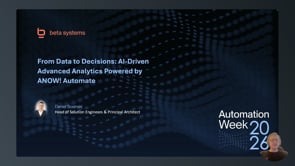
From Data to Decisions: AI-Driven Advanced Analytics Powered by ANOW! Automate

Daniel Sosinski
Head of Solution Engineers & Principal Architect
Follow me for more content

In this session, discover how ANOW! Automate acts as a “Super Orchestrator,” connecting AI-driven platforms and cloud services into seamless, end-to-end analytical pipelines. Learn how to move beyond isolated data workloads and build integrated decision engines that deliver results exactly when they are needed.

Through practical insights, we show how to orchestrate complex analytics processes with precision - ensuring optimal resource usage, cost efficiency, and full operational control across your data landscape.

Video Information:

  • Language: English

  • Subtitles: English, German

Video thumbnail

Author

Daniel Sosinski
Head of Solution Engineers & Principal Architect

Further Resources

Blog Article
competitor-replacement-blog.png

5 Best Infrastructure Automation Tools for DevOps Teams

Fragmented scripts, aging schedulers, and 2 a.m. pages for failed batch jobs are why most DevOps teams start shopping for an infrastructure automation tool. The right platform gives you one code-driven way to schedule, orchestrate, and monitor workloads across your hybrid stack. Below, we break down five infrastructure automation tools DevOps teams evaluate most often and what each is genuinely best for.
Blog Article
competitor-alternatives-blog.png

Automation Orchestration Platforms: 5 Best Tools (2026)

Enterprise automation has outgrown job schedulers. Today’s IT environments span on-premises infrastructure, three major cloud providers, SAP estates, DevOps pipelines, and AI/ML workloads, all of which need to run in a coordinated sequence. According to the Gartner Magic Quadrant for Service Orchestration and Automation Platforms, by 2029, 90% of organizations that currently deliver workload automation will be using service orchestration and automation platforms (SOAPs) to orchestrate workloads and data pipelines across hybrid environments.
Blog Article
beta-systems-featured-images.png

Hybrid Workload Automation: Benefits, Use Cases & Challenges

If your nightly SAP batch run finishes on the mainframe but the cloud analytics job depending on it doesn’t fire until someone checks a dashboard the next morning, you already know the cost of disconnected scheduling. Hybrid workload automation closes that gap by giving IT operations a single control layer that automatically coordinates jobs, data pipelines, and dependencies across on-premises and cloud systems, with no manual handoffs required.