:quality(50))
What is Batch Job Scheduling?
Batch job scheduling is the automated process of grouping related IT tasks and executing them in a defined sequence, at set times, or in response to specific events. Rather than running jobs manually or one at a time, batch scheduling coordinates multiple dependent processes across systems, servers, and environments.
In IT operations, batch jobs typically handle tasks as:
End-of-day financial reconciliations and reporting
ETL (Extract, Transform, Load) data pipeline runs
Payroll processing and billing cycle execution
Database backups and system maintenance routines
Log aggregation and compliance reporting
Modern batch job scheduling has evolved far beyond simple time-based triggers. Today’s enterprise schedulers support event-driven execution, cross-system dependencies, real-time monitoring, cloud-native orchestration, and hybrid cloud orchestration.
This makes them a core component of workload automation and service orchestration platforms (SOAP).
Did You Know?
Did you know that approximately 30% of workload automation jobs now run in public clouds, with an additional 14% in hybrid cloud environments. SaaS-hosted workload automation deployments are growing fastest as enterprises modernize their batch infrastructure.
Key Batch Scheduling Features and Capabilities
Not all batch schedulers are created equal but here are the key features to keep an eye out for.
Event-Driven and Time-Based Triggers
Modern batch schedulers support multiple scheduling models:
Time-based (cron style)
Event-driven (triggered by file arrivals, API responses, or upstream job completions)
Dependency-based (jobs that only run when prerequisite tasks succeed)
This flexibility is essential for dynamic, real-world IT environments where workflows rarely follow a fixed clock.
Cross-Platform Orchestration
Enterprise batch scheduling must span on-premises servers, mainframes, cloud platforms, and SaaS applications.
A robust platform provides a single control plane that can coordinate jobs across AWS, Azure, Google Cloud, SAP, ITSM tools like ServiceNow, and data platforms like Snowflake or Databricks.
Take control of your workload orchestration
Learn how ANOW! Automate handles workload automation and orchestration across diverse IT landscapes!
Real-Time Monitoring and Observability
SLA compliance depends on visibility. Leading schedulers provide real-time dashboards, automated alerts, and anomaly detection so operations teams can identify at-risk jobs before they breach SLAs.
Platforms like ANOW! Observe embed OpenTelemetry-native telemetry directly into the orchestration engine, enabling continuous SLA risk forecasting and automated remediation without manual intervention.
Low-Code Development and Self-Service
Batch scheduling has traditionally required deep scripting expertise.
Modern platforms offer low-code builders and visual workflow designers that enable citizen automators, operators, and developers to build and manage jobs without specialist knowledge.
This accelerates adoption across the business.
Auto-Remediation and Self-Healing
Job failures happen.
Enterprise platforms respond with configurable restart policies, automated escalation, and self-healing workflows that minimize downtime.
Rather than waiting for an on-call engineer, the scheduler detects the failure, retries, reroutes, or pages the right team automatically.
Compliance, Audit Trails, and Data Sovereignty
For regulated industries, particularly BFSI and healthcare, batch scheduling platforms must provide complete audit logs, role-based access controls, and data residency guarantees.
European enterprises should prioritize platforms that offer digital sovereignty, ensuring workload data remains within GDPR-compliant boundaries.
Benefits of Batch Job Scheduling
Implementing a modern batch scheduling platform delivers measurable operational and financial outcomes across IT and business teams. Here’s what you could be missing out on.
1. Reduced Operational Overhead
Manual job management is time-consuming and error-prone. Automating batch execution frees IT operations teams from repetitive monitoring tasks, allowing them to focus on higher-value work.
83% of companies believe in the value of AI-driven tools in identifying issues and automating corrective actions, which ultimately leads to less operational overhead.
2. Improved SLA Compliance
When batch jobs run predictably and observability is built in, SLA compliance improves significantly.
Event-driven architectures ensure jobs trigger exactly when upstream conditions are met, not on a fixed schedule that may not reflect real-world data availability.
3. Faster Time-to-Value for New Automation
Modern platforms with 500+ pre-built connectors and low-code interfaces reduce the time to deploy new automation from weeks to days.
Beta Systems ANOW! Automate, for example, supports zero-touch migration from legacy schedulers and zero-downtime deployment.
4. Scalability Without Rearchitecting
Cloud-native, microservices-based batch schedulers scale dynamically with workload demand.
Unlike legacy platforms that require significant infrastructure investment to handle peak loads, modern Kubernetes-native schedulers like ANOW! Automate expand automatically, keeping performance consistent whether you’re running hundreds or millions of jobs.
Ready to modernize your batch scheduling?
Beta Systems ANOW! Suite combines enterprise workload automation, real-time observability, and AI-driven orchestration in a single cloud-native platform. See how ANOW! accelerates your migration from legacy schedulers.
Common Challenges in Batch Job Scheduling
Even with the right tooling, batch scheduling at enterprise scale introduces operational and architectural challenges that teams must proactively address.
Managing Cross-System Dependencies
Modern IT environments span dozens of systems. Coordinating batch jobs across these environments requires robust dependency management.
When a single upstream system delays its output, downstream jobs queue up or fail entirely, cascading into SLA breaches.
A unified orchestration platform provides the dependency mapping and event-driven triggers needed to handle these scenarios gracefully
Escalating Costs from Legacy Vendors
Organizations running batch scheduling on legacy platforms from BMC, Broadcom, or similar vendors face a well-documented challenge: pricing models that increase year over year, with opaque per-module licensing and limited flexibility.
IT leaders evaluating their options should request full TCO modeling across a 3-5 year horizon before renewing contracts.
Lack of Visibility and Proactive Monitoring
Many legacy batch schedulers provide reactive monitoring. This means they alert teams after a failure has occurred. In business-critical environments, this is not enough.
The shift to proactive, real-time observability, where the scheduler predicts and prevents SLA breaches, is a key driver behind the migration to modern workload automation platforms.
Overcome Cloud and DevOps challenges today
Watch our webinar on overcoming cloud and DevOps challenges with ANOW! and see how DevOps automation and modern observability transform IT operations.
Hybrid Cloud Complexity
Enterprises operating in hybrid environments face a specific challenge: maintaining consistent batch scheduling behavior across on-premises infrastructure and multiple cloud platforms.
Legacy schedulers were not designed for this complexity.
Cloud-native platforms built on microservices and Kubernetes, like ANOW! Automate, handle hybrid environments natively, providing consistent execution and visibility regardless of where jobs run.
Explore how modern enterprise workflow tools and cloud scheduling software support scheduling, orchestration, and observability across hybrid environments.
Top 4 Batch Job Scheduling Tools and Software
Platform | Key Features | Integrations | Ease of Use | |
|---|---|---|---|---|
Beta Systems ANOW! Automate |
| 500+ native connectors (SAP, AWS, Azure, GCP, Snowflake, ServiceNow, and more) | Low-code interface, browser-based, faster onboarding and shorter training time compared to other vendors | |
BMC Control-M | Hybrid orchestration, predictive SLA management, jobs-as-code | Strong data platform and ITSM connectivity (Snowflake, Azure Data Factory, Airflow) | Complex setup; steep learning curve for non-BMC teams | |
Redwood RunMyJobs | SAP-endorsed, 1,000+ SAP templates, 99.95% uptime SLA | Deep SAP ecosystem (S/4HANA, BTP, ECC); narrower breadth outside SAP | Low-code drag-and-drop; accessible for SAP-centric teams | |
Apache Airflow (Open Source) | Python-based DAG scheduling, rich plugin ecosystem, community-driven | Broad integrations via community plugins; requires custom engineering | Developer-friendly but requires scripting knowledge and infrastructure management |
Beta Systems ANOW! Automate
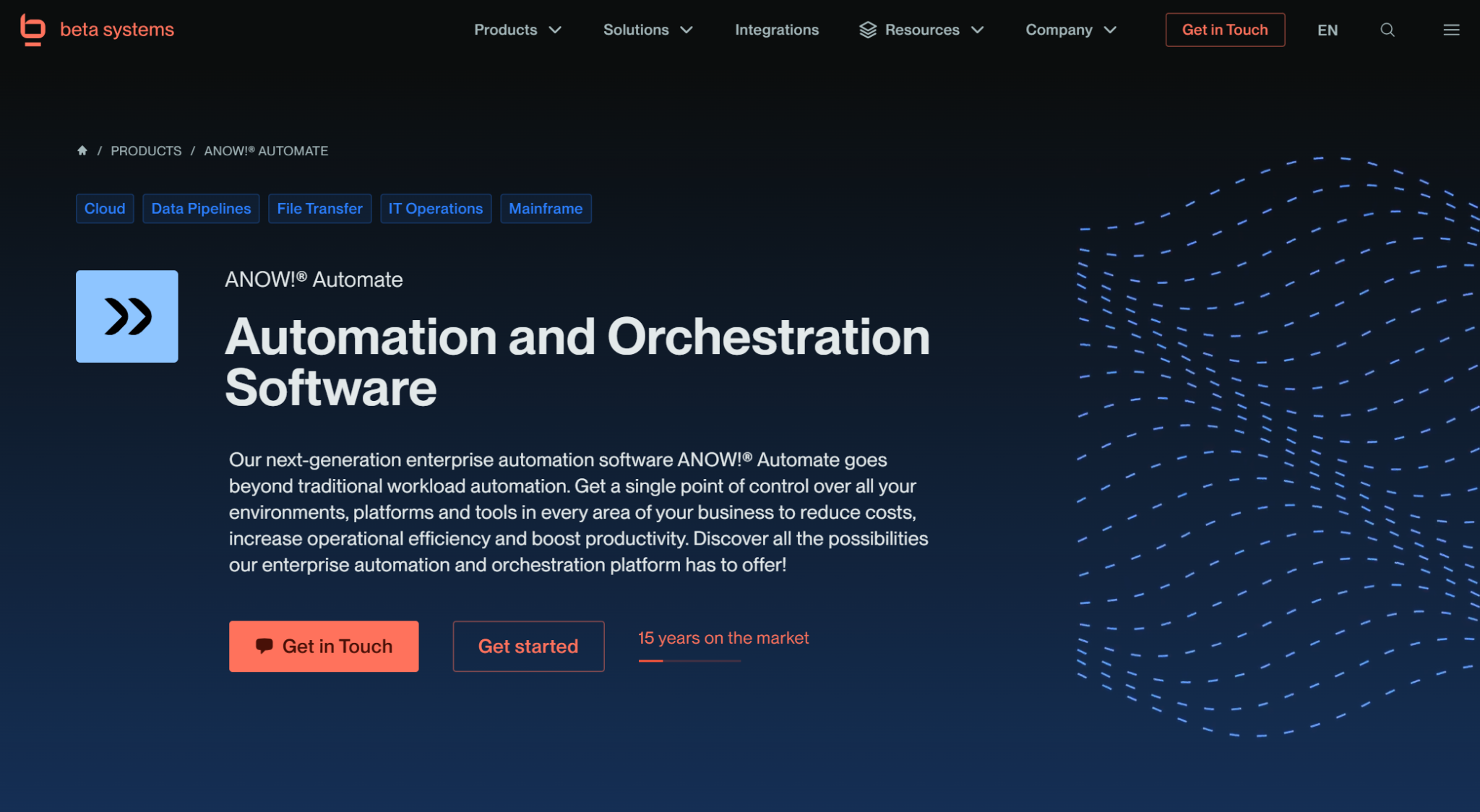
Beta Systems ANOW! Automate is a modern, cloud-native workload automation and batch scheduling platform built specifically for large enterprises operating in hybrid and multi-cloud environments.
Backed by 40 years of enterprise infrastructure experience, Beta Systems has rebuilt its automation offering from the ground up.
Key batch scheduling capabilities include:
Event-driven, time-based, and dependency-based scheduling across on-premises, cloud, and mainframe environments
500+ native out-of-the-box integrations including SAP, AWS, Azure, Google Cloud, Snowflake, Databricks, ServiceNow, and Jira
Contextual Intelligence and Dynamic Workflow generation, adapting execution logic in real time based on data, conditions, and event triggers for more intelligent data workflow automation
ANOW! Observe which offers purpose-built observability with OpenTelemetry-native telemetry for SLA risk forecasting and automated remediation
Zero-downtime deployment, browser-based access, and zero-touch migration toolkits for transitions from legacy vendors
Digital sovereignty for European enterprises, with GDPR-aligned architecture and full data residency control
BMC Control-M
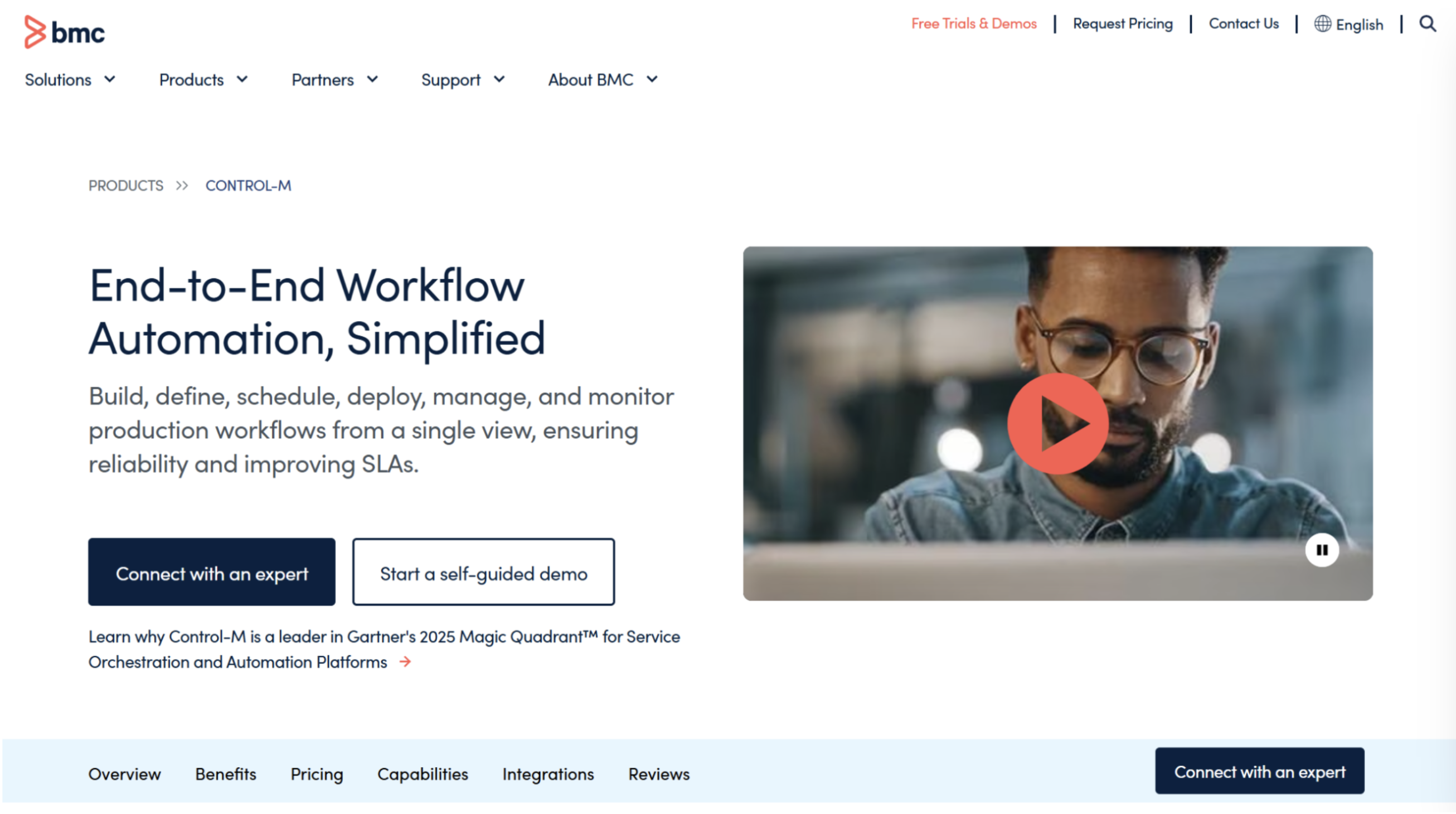
BMC Control-M is one of the most established workload automation platforms on the market, providing unified orchestration across mainframe, distributed, and cloud environments. It offers mature SLA management, jobs-as-code capabilities, and deep integrations with data platforms including Snowflake and Azure Data Factory.
Control-M is best suited to large enterprises already heavily invested in BMC’s broader ecosystem with established in-house expertise. However, user reviews consistently flag escalating licensing costs and a complex, aging interface as significant pain points.
Pro-Tip
Organizations evaluating a Control-M replacement can explore Beta Systems’ structured migration pathway.
Redwood RunMyJobs
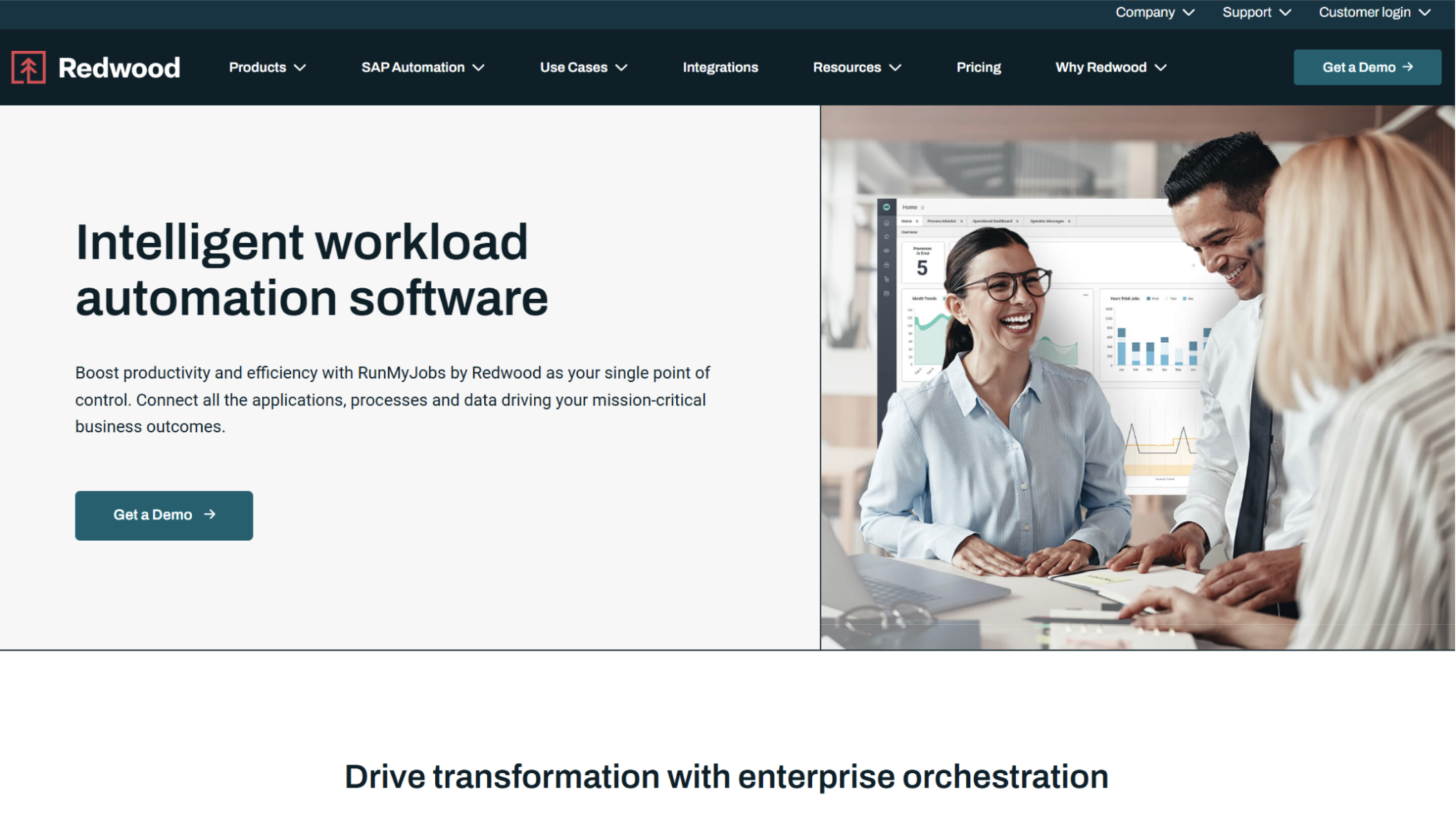
Redwood RunMyJobs is the only SAP-Endorsed workload automation platform, making it a strong option for enterprises running SAP S/4HANA environments.
It offers 1,000+ pre-built SAP templates, a 99.95% uptime SLA guarantee, and purpose-built support for RISE with SAP migrations.
Its primary limitation is integration breadth outside the SAP ecosystem.
For organizations with complex, multi-cloud orchestration requirements that extend beyond SAP workloads, a broader platform like the ANOW! Suite will provide stronger coverage.
Apache Airflow (Open Source)

Apache Airflow is a popular open-source workflow orchestration platform widely used by data engineering teams for building and scheduling Python-based DAGs (Directed Acyclic Graphs).
Its rich plugin ecosystem and community support make it attractive for data-first organizations.
However, Airflow is not a true enterprise batch scheduler. It requires significant engineering effort to maintain, lacks enterprise-grade SLA management and observability, and does not offer the cross-platform dependency management or compliance controls that enterprise IT operations teams require.
For organizations considering Airflow as a primary scheduler, reviewing the Apache Airflow replacement use case is a useful starting point.
Best Practices for Effective Batch Job Scheduling
Deploying a batch scheduler is only the first step. These practices ensure your automation program runs reliably at scale.
Define Dependencies Before You Automate
Map every upstream and downstream dependency for each batch process before configuring your scheduler.
Missing a critical dependency, such as a data feed that must complete before a financial report runs, creates cascading failures that are difficult to diagnose under pressure.
Understanding what is workflow orchestration and how dependencies are modeled is a must for a successful scheduling architecture.
Build for Observability from Day One
Don’t treat monitoring as an afterthought. Configure SLA thresholds, alerting rules, and escalation paths as part of the initial job design.
Use platforms that provide proactive telemetry so your team can resolve issues before they impact business outcomes.
Explore the future of workload automation to understand how observability is becoming inseparable from scheduling.
Standardize with Jobs-as-Code
Store job definitions in version-controlled repositories using a jobs-as-code approach.
This makes sure you can collaborate between operations and development teams, supports CI/CD pipeline integration, and provides a rollback path when changes cause issues.
Platforms that support Git-native workflows (including branching, tagging, and diffing) make this significantly easier to implement at scale.
Plan Your Migration Carefully
If you’re moving from a legacy scheduler, avoid a big-bang migration.
A phased approach by migrating workload categories in stages reduces risks and allows teams to validate behavior in the new environment before decommissioning the old one.
Beta Systems provides zero-touch migration toolkits that automate the conversion of existing workload definitions, especially on an enterprise level, significantly reducing manual effort.
Schedule Jobs Across Platforms with Beta Systems
Batch job scheduling is the operational backbone of enterprise IT. The gap between legacy schedulers and modern platforms has never been wider.
Organizations that continue to rely on aging, expensive tools from BMC or Broadcom are paying more, getting less, and falling behind on the visibility and scalability that modern hybrid environments demand.
Beta Systems ANOW! Suite delivers enterprise-grade batch scheduling, dynamic workflow orchestration, and purpose-built observability in a single cloud-native platform
Ready to see it in action?
Visit our website to book a demo or talk directly with a workload automation expert.
:quality(50))
:quality(50))
:quality(50))