:quality(50))
What is Hybrid Cloud Orchestration?
Hybrid cloud orchestration is the automated coordination of workloads, resources, and services across a combination of private clouds, public clouds (AWS, Azure, Google Cloud), and on-premises infrastructure, enabling hybrid workload automation through one unified platform.
It goes beyond simple cloud automation or workflow orchestration. Hybrid cloud orchestration manages dependencies between systems, enforces execution order, handles failures and retries, and provides end-to-end visibility across the entire IT landscape, regardless of where workloads are running.
In Practice
A bank’s end-of-day batch process may trigger jobs on a mainframe, pass data through an AWS Glue pipeline, run risk calculations in Azure, and update records in an on-premises SAP system. Hybrid cloud orchestration coordinates all of this as a single, managed workflow.
Gartner defines platforms that deliver this capability as Service Orchestration and Automation Platforms (SOAPs), a market category covering solutions that “empower organizations to manage and automate their entire technology stack, including workloads, workflows, resource provisioning, and data pipelines.”
What are the Benefits of Hybrid Cloud Orchestration?
Here’s why you should be considering hybrid cloud orchestration for your operational workflows.
Unified Visibility Across Your Entire IT Landscape
Without orchestration, hybrid environments create operational blind spots.
Teams managing on-premises infrastructure, cloud workloads, and SaaS services each use their own tools, and no one has a complete picture.
Enterprise orchestration platforms provide a single pane of glass across all environments, so IT operations and data teams can see job status, SLA health, and pipeline performance in real time.
This is especially critical for IT operations management in regulated industries, where auditability and full execution traceability are non-negotiable.
Cost Optimization and Resource Efficiency
With hybrid orchestration, you also unlock intelligent workload placement; running jobs where compute is cheapest or most available at any given moment.
Workloads can be shifted from private cloud to EC2 spot instances or public cloud burst capacity based on cost and demand, reducing infrastructure waste.
This is a core use case for FinOps teams managing cloud spend across multi-cloud environments.
By consolidating multiple schedulers and point tools into a single platform, enterprises also eliminate redundant tooling costs and reduce the administrative overhead that comes with managing fragmented automation estates.
Business Continuity and SLA Compliance
Hybrid environments introduce complex dependency chains. If even one system is unavailable, downstream workloads can fail silently or cascade.
A capable orchestration platform tracks dependencies across environments in real time, triggers automated recovery actions, and flags SLA risks before they become breaches.
This is foundational to event-driven automation at enterprise scale, where time-sensitive batch processing, data delivery, and regulatory reporting cannot tolerate unmanaged failures.
Compliance and Data Sovereignty
Hybrid orchestration platforms can enforce data residency laws and regulatory requirements by controlling where workloads run and where data moves.
For European enterprises operating under GDPR or DORA, this means workloads can be explicitly bound to compliant environments, with full audit trails for every execution.
Pro Tip
Look for orchestration platforms that provide built-in PII detection and redaction for workload outputs as this removes a significant compliance burden from engineering teams managing data pipelines across jurisdictions.
Accelerated Digital Transformation and AI Readiness
Gartner’s 2025 SOAP Magic Quadrant projects that by 2029, 90% of organizations delivering workload automation will be using service orchestration and automation platforms to orchestrate workloads and data pipelines in hybrid environments
The shift is being driven by AI and data initiatives: AI models and ML pipelines require reliable, orchestrated data delivery across cloud and on-premises systems.
This is something that traditional schedulers simply cannot provide.
What Makes Hybrid Cloud Orchestration Difficult?
Hybrid cloud orchestration, though beneficial, isn’t the most straightforward process to implement. Here are the factors that differentiate it.
Integration Complexity Across Heterogeneous Systems
Enterprise IT landscapes are not clean.
Most large organizations run a combination of mainframes, on-premises ERP systems (SAP, Oracle), modern cloud services, SaaS platforms, and custom applications, often accumulated across decades.
Building and maintaining reliable integrations between all of these environments is a significant engineering challenge.
Key difficulties include:
Proprietary APIs and incompatible data formats across legacy and modern systems
Managing authentication and credentials securely across cloud providers and on-premises tools
Handling version drift in systems that update independently on different schedules
Without a platform with broad, native integration coverage, teams resort to custom scripting, which can create shadow IT debt that grows faster than it can be managed.
Security and Access Control Across Environments
Hybrid environments multiply the attack surface. Workloads cross network boundaries, credentials must be managed across cloud providers, and sensitive data moves between systems with different security postures.
Enforcing the principle of least privilege across a hybrid estate, while maintaining segregation of duties, requires orchestration platforms with robust role-based access controls and fine-grained permission management built in.
Security concerns are compounded in regulated sectors: BFSI organizations, in particular, must ensure that workloads running in public cloud environments meet the same security standards as on-premises infrastructure.
Migration Complexity and Legacy Lock-In
Many enterprises are still running workload automation on platforms that were architected before hybrid cloud existed.
Migrating off these systems, while keeping business-critical processes running, is a high-stake project. Legacy vendors often use proprietary job definition formats, making portability difficult without significant re-engineering.
This is exactly why migration strategy has become a core part of the orchestration platform evaluation process. Platforms that provide zero-touch migration toolkits and maintain job definitions in open, portable formats (JSON/YAML) significantly reduce the risk and cost of transition.
Pro Tip
Many organizations still run mainframe workloads alongside modern cloud systems. Hybrid orchestration platforms that bridge both environments, without requiring separate tools for each, are a key driver of enterprise consolidation decisions in 2026.
How Does Hybrid Cloud Orchestration Function?
Here are the main functional areas to know.
Centralized Orchestration Layer with Universal Connectivity
At the core of hybrid cloud orchestration is a centralized orchestration engine that sits above individual cloud and on-premises environments.
This engine maintains a unified definition of all jobs, workflows, and dependencies, regardless of where they execute. It communicates with each environment through native connectors, APIs, or lightweight agents by:
Issuing execution instructions
Monitoring status
Handling failures without requiring changes to the underlying systems
Modern orchestration platforms use Kubernetes scheduling and container-native architectures to scale the orchestration layer dynamically, making sure it can handle peak workload volumes without becoming a bottleneck itself.
Event-Driven and Dependency-Based Triggering
Unlike legacy schedulers that rely purely on time-based triggers, modern hybrid orchestration platforms support three execution models:
Trigger | How It Works | Best For | |||
|---|---|---|---|---|---|
|
| Batch processing, end-of-day runs | |||
|
|
| |||
Dependency-based |
| Complex multi-system workflows |
In practice, enterprise workflows combine all three. A batch job may run at midnight, only if an upstream data pipeline is completed, and only after a cloud resource provisioning event confirms availability.
Observability and Closed-Loop Automation
Effective hybrid orchestration monitors workloads in real time and acts on what it sees. Modern platforms embed observability directly into the orchestration engine, emitting metrics, logs, and traces (using standards like OpenTelemetry) that feed into SLA dashboards and anomaly detection systems.
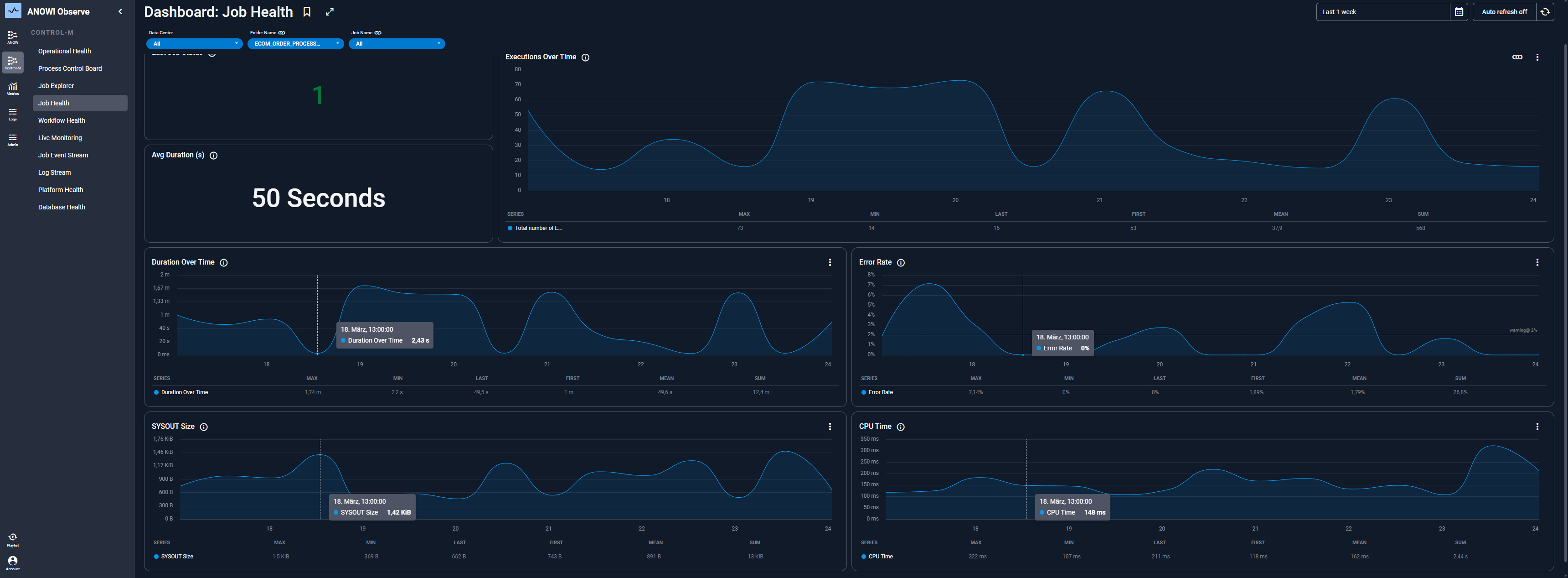
When a job deviates from expected runtime, or a dependency fails, the orchestration layer can trigger automated recovery workflows such as restarting failed jobs, escalating alerts, or re-routing workloads to healthy environments without human intervention.
This log management and self-healing capability is what separates enterprise orchestration from basic workload automation.
Best Solutions for Seamless Hybrid Cloud Orchestration?
Wondering which tools to get started with? Here are the best in the market that you should know.
1. ANOW! Automate by Beta Systems: Best for Enterprise Hybrid & Cloud-Native Orchestration
ANOW! Automate is a cloud-native workload automation and orchestration platform built specifically for complex, hybrid enterprise environments.
Recognized as a Leader in the 2025 Gartner Magic Quadrant for Service Orchestration and Automation Platforms, ANOW! is the SOAP platform of choice for large enterprises managing thousands of servers, cross-platform data pipelines, and business-critical processes across hybrid and multi-cloud architectures.
Key capabilities for hybrid cloud orchestration include:
600+ native integrations with out-of-the-box connectors for AWS, Azure, Google Cloud, SAP, Snowflake, Databricks, Kubernetes, and more, the most of any WLA vendor
Cloud-agnostic deployment that runs natively on AWS, Azure, and GCP; supports SaaS, private cloud, and on-premises, and lets you switch deployment models without disruption
Infinite Integration which connects to virtually any system, including proprietary and legacy platforms, via API, CLI, or JavaScript-based integration logic
Contextual Intelligence with multi-level dynamic variables adapt workflows to real-time conditions, enabling generation of hundreds of thousands of unique workflows from minimal definitions
OpenTelemetry-native observability that embeds real-time telemetry directly into the orchestration engine for AI-driven anomaly detection and SLA risk forecasting
Best suited for: Large enterprises in BFSI, manufacturing, and retail managing complex, cross-system workflows across hybrid and multi-cloud environments, particularly those migrating off legacy platforms like Broadcom or BMC Control-M.
→ Book a Demo of ANOW! Automate
2. BMC Control-M: Established Enterprise Orchestration for Complex Workloads
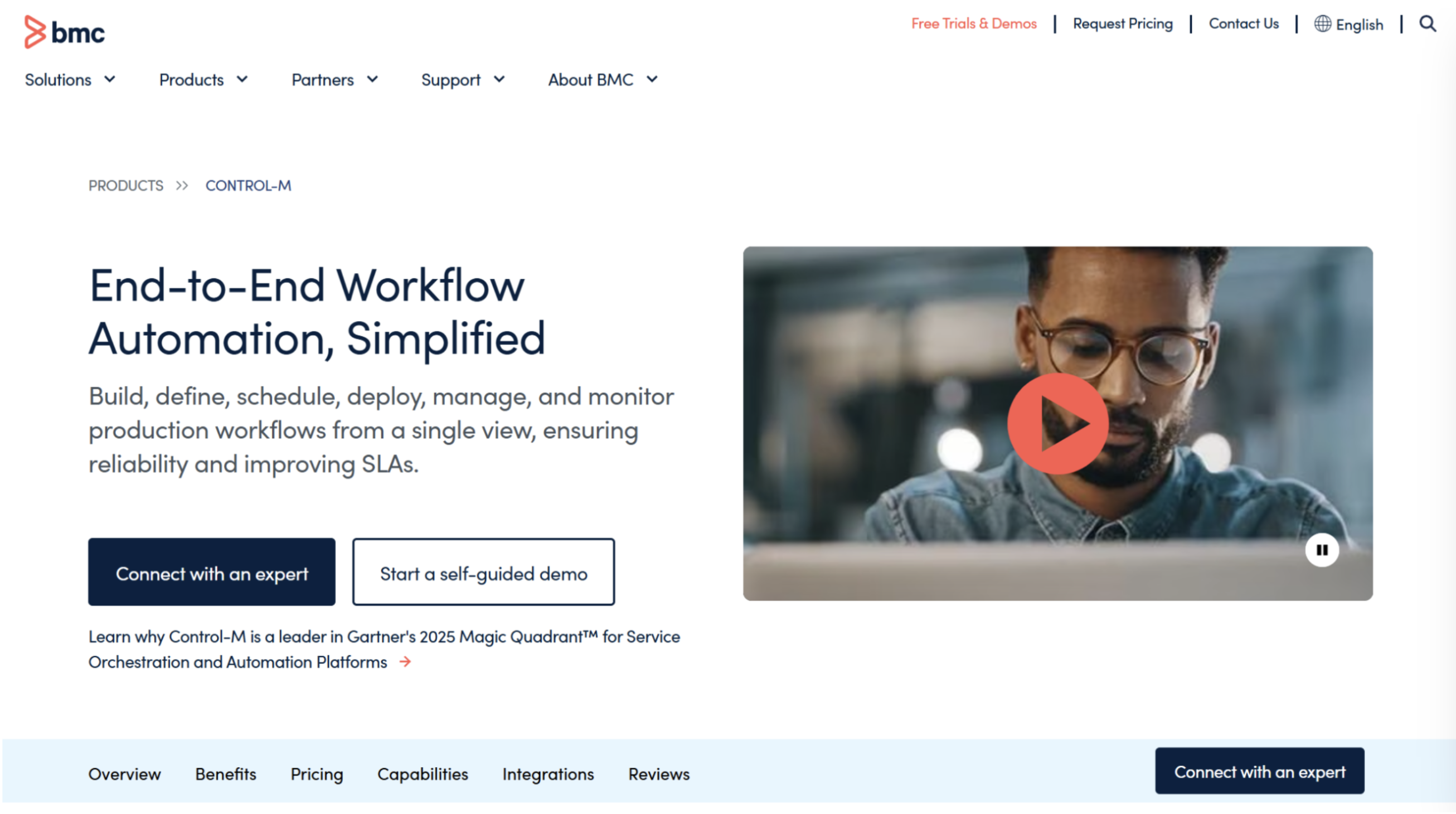
BMC Control-M is one of the most widely deployed enterprise workload automation platforms globally and a fellow Leader in the 2025 Gartner SOAP Magic Quadrant.
Its orchestration capabilities span mainframes, multicloud, and cloud-native environments through a Unified View that provides a single interface for building, running, and managing complex workloads across self-hosted and SaaS deployments.
Control-M has made meaningful investments in cloud-native capabilities in recent years, including support for data pipelines, AI/ML orchestration, and a GenAI assistant (Jett) that helps users troubleshoot workflows and detect anomalies using natural language.
Where it has limitations:
Total cost of ownership: Control-M’s licensing costs, combined with personnel requirements for skilled administrators, can be difficult to justify for organizations with less complex scheduling needs
Pricing transparency: Unlike ANOW!, Control-M’s pricing model can be opaque, with costs scaling significantly as workload volumes grow. It also charges separately for add-ons such as MFT module due to the base license covering only core scheduling
Organizational disruption: BMC split into two independent companies in 2025 (BMC and BMC Helix), which has raised customer concerns about long-term integration continuity and support clarity
No native AI agents: While Jett provides GenAI assistance, Control-M does not yet offer native AI agents for autonomous operational purposes
Best suited for: Enterprises already invested in the BMC ecosystem that need proven, global-scale hybrid orchestration and have the budget and staffing to support an enterprise-grade platform.
Compare BMC Control-M with other leading cloud scheduling software before making a long-term investment.
3. Apache Airflow: Open-Source Orchestration for Data Engineering Teams
Apache Airflow is the most widely adopted open-source workflow orchestration tool in the data engineering world, with strong adoption across cloud-native and hybrid environments.
Built around a DAG (Directed Acyclic Graph) model for defining pipeline dependencies, Airflow is particularly popular for orchestrating Python-based data workflows, automating data workflows, and managing ML pipelines across cloud environments.
It integrates natively with AWS, Azure, and GCP, and managed versions are available through all three major cloud providers, making it a common choice for engineering teams that want flexibility without vendor lock-in.
→ A useful starting point for teams comparing approaches is Beta Systems’ Apache Airflow replacement resource.
Where it has limitations:
Engineering overhead: Airflow requires significant infrastructure expertise to deploy, maintain, and scale reliably. Managing workers, schedulers, and metadata databases in production is not trivial
No built-in SLA management: Airflow lacks native SLA enforcement and observability tools adequate for business-critical operations. Custom monitoring solutions are typically required
IT/business workload gap: Airflow is designed for data pipelines, not for enterprise IT workloads spanning SAP, mainframes, ITSM systems, or managed file transfer, making it a partial solution for organizations with broader orchestration needs
Governance limitations: Enterprise requirements around role-based access, audit trails, and policy enforcement require significant custom development on top of base Airflow
Best suited for: Data engineering teams and organizations with strong Python expertise that need flexible, cloud-native pipeline orchestration and have the engineering capacity to operate and maintain the platform themselves.
Ready to Optimize Your Hybrid Cloud Strategy with Beta Systems?
Managing workloads across private clouds, public clouds, and on-premises infrastructure without a unified orchestration layer creates operational risk, compliance exposure, and engineering debt that compounds over time.
Modern enterprises need a platform that handles the full complexity of hybrid IT, not a collection of point tools that solve individual pieces.
ANOW! Automate is built for exactly this challenge.
If you’re evaluating your hybrid cloud orchestration strategy for 2026, explore the ANOW! Suite, including ANOW! Automate and ANOW! Observe.
Eliminate Hybrid Cloud Complexity at Scale.
Stop stitching together schedulers, scripts, and cloud tools. ANOW! Automate gives you one platform to coordinate workloads, enforce dependencies, and maintain full visibility across hybrid environments.
:quality(50))
:quality(50))
:quality(50))