Datasheet

Improve JCL Quality and Production Reliability with SmartJCL

Ensure JCL quality and identify potential errors before they impact mainframe production. SmartJCL helps organizations automate JCL validation, consistently enforce standards, and maintain reliable operations across z/OS environments. A mainframe is a large computer designed for many simultaneous users and critical applications. More in the glossary Operating systems manage computer hardware and software resources. More in the glossary

  • Prevent Production Errors Early: Identify JCL, file, and program issues before production to reduce the risk of costly abends and delays.

  • Ensure JCL Quality and Standards: Automate validation and formatting while consistently enforcing organization-specific standards across teams.

  • Streamline Changes and Development: Automate JCL modifications and integrate SmartJCL with ISPF, Visual Studio Code, IWS z/OS, and Control-M to support efficient workflows.

Identify JCL Errors Before They Impact Production

SmartJCL provides comprehensive JCL validation, checking syntax, program availability, dataset allocation, and access authority. Potential issues can be identified and resolved before execution. Integration with leading schedulers such as IWS z/OS and Control-M also enables variable substitution and production sequence checks for more reliable operations.

Automate JCL Management and Enforce Standards

From automatic JCL reformatting and mass changes to customized validation rules, SmartJCL enables consistent and efficient JCL management. Integration with ISPF and Visual Studio Code provides developers with immediate feedback in their familiar working environment, helping organizations modernize mainframe workflows and address skills gaps.
Further Resources

Blog Article

The Road to Enterprise Orchestration

Enterprise IT has never been more complex, and automation, in particular, continues to evolve rapidly as we head toward the age of agentic AI. An effective organization must coordinate workloads across on-premises infrastructure, multiple cloud providers, SaaS applications, Kubernetes clusters, APIs, and AI-powered services. In today’s business climate, IT processes can no longer run optimally on a single platform; they must span the entire technology ecosystem. Traditional job scheduling, therefore, is no longer enough in this environment. Instead, IT teams need to look towards a future of Enterprise Orchestration. This new approach coordinates entire business processes across the digital enterprise instead of automating only single tasks. In this article, we explore the evolution of enterprise automation and the road to enterprise orchestration.
Blog Article

Where Enterprise Automation Is Heading: Insights from the 2026 Gartner® Magic Quadrant™ for SOAP

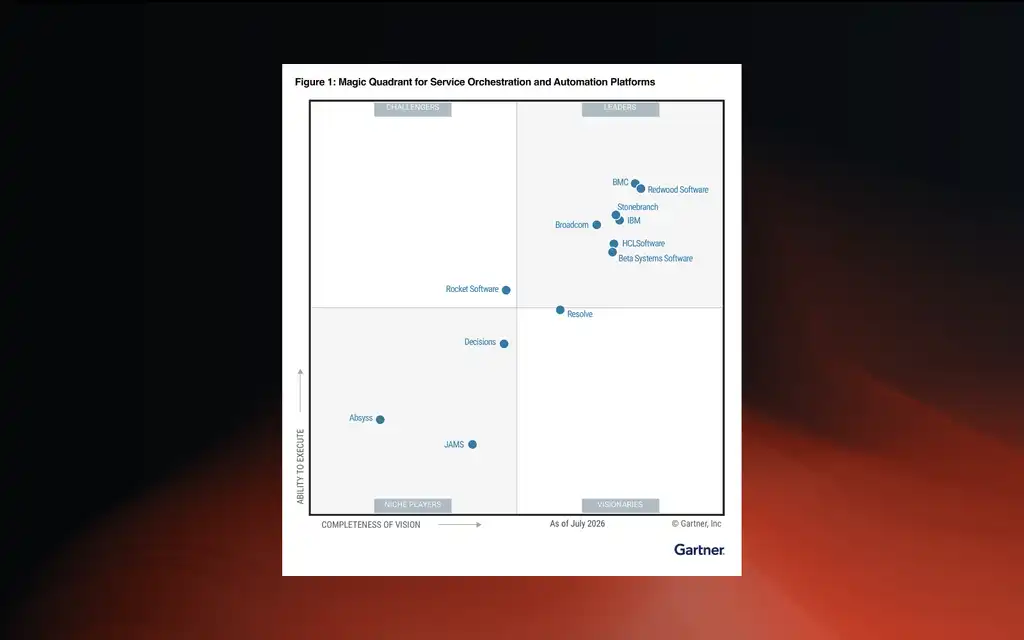
The move from traditional workload automation to intelligent, end-to-end orchestration is accelerating. This change is one of the clearest signals we've seen from the 2026 Gartner® Magic Quadrant™ for Service Orchestration and Automation Platforms (SOAP), and it comes at an important moment for Beta Systems. For the second year in a row, Beta Systems has been positioned as a Leader in the Gartner Magic Quadrant for SOAP. But beyond vendor positioning, the 2026 report provides an important view into where enterprise automation is heading. The evolution is not simply from job scheduling to more sophisticated workload automation. SOAPs are increasingly becoming the operational layer connecting applications, infrastructure, data pipelines, cloud services, and now AI agents. Here are our key takeaways from the 2026 research.
Interview

Eduardo Raygadas de la Torre on Mainframe, AI & Modern Automation

Eduardo Raygadas de la Torre from Versaria shares his perspective on the evolution of enterprise IT. He explores how Beta Systems combines proven mainframe expertise with AI, automation, and observability to support modern hybrid IT environments – and highlights the opportunities these technologies create for customers in the Mexican market.