:quality(50))
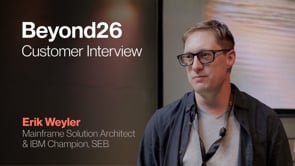
The conversation also explores the growing importance of data sovereignty and the need for organizations to maintain control over their data and technology environments. As enterprise IT continues to evolve, Erik emphasizes the value of solutions that simplify operations, increase transparency, and enable organizations to integrate established mainframe systems with modern cloud technologies.
Drawing on his experience with Beta Systems and solutions such as XINFO and SmartJCL, Erik also highlights the importance of close collaboration between customers and technology providers. Open dialogue, shared expertise, and a strong understanding of real-world requirements are key to developing solutions that meet today's challenges while preparing organizations for the future of enterprise IT.
Why did you attend Beyond26?
Well, I want to talk to you about some HORIZONT products. We use XINFO and SmarJCL at SEB, where I work.
Those topics are always interesting to me, and there were some presentations about them. But I also get to meet the people that work with the products, of course, so I get to influence the development, which of course is important to me and to SEB.
What was the highlight of the event in your experience?
Well, of course, the highlight for me was being in the panel on stage speaking about the modernization of the mainframe. And we had some tough questions, but I think we answered them all, actually.
So I'm quite happy about that.
How would you describe the balance between experience and innovation at Beta Systems?
Well, I think you have to go that way because everyone is talking about hybrid cloud now. Everyone seems to realize only the cloud won't cut it. Only the mainframe is not an option either anymore. But I think the two technologies marry more and more. Tobi from IBM showed it in his presentations. So you can see it both from a CIS admin perspective and from a developer perspective, you can see it too, that the technologies are available on both platforms. And since you use both sides of the coin, so to speak, you as a vendor, you have to have solutions that work for both. It would be too big of a hassle if you have to go use these tools when you do that kind of work and use these tools when you do that kind of work. They have to go together.
What role does automation play in your organization?
So, the way we try to enable both on the cloud side and on the mainframe side is make things as simple as possible for users. Automation is obviously key in all of that. But sovereignty comes more and more, you hear about it more and more and more. The cloud providers are thinking about it too, but the way I see it, the US Cloud Act, well, it does say that the US government can use a warrant to get your information, even if the data centers are in Europe. The only solution really for me, the way I see it, is that you run your things on-prem and it's your data. That's the only real way I see it to protect our customers' data. So that's a topic that comes up more and more and more and more. So I think we'll see more of it. So actually, I think we probably will have a push towards mainframe again, but then the automation will be key. We can't have clunky ways of working with the mainframe. It has to be as fast and easy and transparent as it is in the cloud environments.
What is your key take away from Beyond26?
The key point is meeting peers and you guys and the vendors. So that's the greatest thing. And of course, the topic of AI always comes up. And that's very interesting to have those discussions because it's still a little bit fluid, but if you have the conversations, people start thinking about it and realize, okay, we can actually achieve using AI within these different contexts in a good way. So it's key, I think, that customers and vendors speak rather than just the vendors coming up with something that maybe doesn't work. But that's why I'm so happy that I'm here, because I can talk to the people that actually work developing the products.
:quality(50))
:quality(50))
:quality(50))