What Is SAP Orchestration? (A Simple Definition)
Before going further, it helps to separate two things that get lumped under the same label. “SAP orchestration” has two distinct meanings in 2026, and mixing them up is the fastest way to end up in the wrong conversation with the wrong vendor.
Meaning | What it is | Where it lives |
|---|---|---|
SAP Process Orchestration (PO) | On-premise middleware combining Business Process Management (BPM), Process Integration (PI), and Business Rules Management (BRM) into one integration platform | Part of the SAP NetWeaver family |
SAP Generative AI Orchestration | A managed service that coordinates LLM calls, prompt templates, content filtering, and grounding/RAG for AI applications | Part of SAP AI Core, inside the Generative AI Hub |
This guide focuses primarily on the first meaning, SAP Process Orchestration, since that's what most IT teams mean when they search for “SAP orchestration” today.
The second meaning is newer and growing fast as more enterprises build AI agents on top of SAP data, so we'll touch on it briefly where it's relevant.
SAP Process Orchestration: Core Components Explained
SAP Process Orchestration packages three separate SAP tools into a single integrated platform within the NetWeaver family. It acts as the central integration and automation layer for business processes, handling everything from a simple two-step approval to a cross-system workflow that touches five different applications.
When done well, it reduces manual data entry, improves data quality, and lowers the total cost of maintaining point-to-point integrations. SAP PO has three core components, and understanding what each one does is the foundation for everything else in this guide.
SAP Business Process Management (BPM)
BPM models, designs, executes, and monitors business processes end to end. It handles workflows ranging from a simple approval chain to complex processes that span multiple systems and involve both automated steps and human tasks.
A common use case is automating a purchase-to-pay process: a purchase requisition triggers an approval workflow, routes to the right approver based on spend thresholds, and on approval, kicks off downstream steps in procurement and finance without anyone manually re-entering data. Invoice approval workflows follow a similar pattern.
In plain terms, this means fewer manual handoffs, less room for data-entry errors, and faster cycle times for processes that used to depend on someone remembering to forward an email.
SAP Process Integration (PI) and the AEX
PI is the middleware layer that lets different systems communicate, whether they're SAP or not. It handles the actual message routing, protocol translation, and data mapping between endpoints.
The Advanced Adapter Engine Extended (AEX) is the connectivity component within PI, responsible for handling adapter-based communication and message routing without requiring the full dual-stack PI installation.
PI is one component inside SAP PO, but not a synonym for the whole platform.
People use the terms interchangeably in casual conversation, but they're not the same thing.
A practical example: connecting an SAP ERP system to a third-party logistics provider or an external CRM, where PI translates between SAP’s data formats and whatever format the external system expects, and routes the message reliably even when one side is temporarily unavailable.
SAP Process Orchestration vs. SAP Integration Suite: Key Differences
This is one of the most common questions SAP teams are searching right now, and it deserves more than a surface-level answer. With PO’s end of maintenance approaching, teams are actively deciding between staying on PO, moving to SAP Integration Suite, or looking outside the SAP stack entirely.
The comparison breaks down across three angles: architecture, future-proofing, and deployment model.
Factor | SAP Process Orchestration (PO) | SAP Integration Suite |
|---|---|---|
Deployment model | On-premise (NetWeaver-based) | Cloud-native, runs on SAP BTP |
Integration architecture | Traditional ESB-style middleware | iPaaS with API-led connectivity |
Maintenance status | Standard maintenance ends Dec 31, 2027 | Actively developed, part of SAP's current roadmap |
Migration complexity | N/A (legacy platform) | Moderate to high, depending on integration volume and custom BPM/BRM logic |
Clean-core compatibility | Limited; custom code often lives close to the core | Built for clean-core, keeps customization outside the ABAP stack |
Pricing model | Included in existing NetWeaver licensing | Consumption-based, tied to BTP credits |
SAP roadmap alignment | Being phased out | SAP's designated strategic successor |
Core Functional Differences
The fundamental difference is architectural. SAP PO is on-premise middleware built on NetWeaver, while SAP Integration Suite is a cloud-native iPaaS running on SAP BTP. That's not a minor technical detail. It changes how you deploy, scale, patch, and pay for the platform.
SAP has been direct about the direction of travel here: Integration Suite is the strategic replacement for PO, not a parallel option. It supersedes PO in SAP’s own roadmap, which means new integration capabilities, AI features, and API management tooling are landing on Integration Suite, not PO.
That doesn’t mean every organization should migrate tomorrow. If your environment is still largely SAP ECC with PO handling a manageable number of integrations, the calculus is different than if you're mid-migration to S/4HANA and building integrations for a platform that needs to last another decade.
Which One Is Right for Your Organization?
A simple way to frame the decision:
Still on legacy ECC, staying there for now: PO can keep running through its maintenance window, but treat any new integration work as an opportunity to pilot Integration Suite rather than adding more logic to a platform with a fixed end date.
Actively migrating to S/4HANA: Build new integrations on Integration Suite from the start. Retrofitting PO-based integrations after an S/4HANA go-live adds cost you can avoid by sequencing the work correctly.
Running hybrid SAP and non-SAP environments: This is where the decision gets more complex, because Integration Suite handles SAP-to-cloud and SAP-to-SAP integration well, but coordinating SAP processes with the rest of your enterprise IT estate (job scheduling, file transfers, DevOps pipelines, non-SAP applications) is a different problem that iPaaS tools aren't built to solve alone. More on that below.
Pro tip:
Don’t treat this as an all-or-nothing migration. Most enterprises run PO and Integration Suite in parallel for a transition period, moving integrations over by business process rather than in one cutover. Map your PO integration inventory first; you can't sequence a migration you haven't measured.
SAP Process Orchestration End of Life: What It Means and How to Prepare
Standard maintenance for SAP Process Orchestration ends December 31, 2027, with an option for paid extended maintenance through 2030, according to SAP’s own NetWeaver 7.5 maintenance strategy update. After the standard maintenance window closes, PO stops receiving new features, security patches, or standard support unless you're paying for the extension.
This section is about the calendar and the risk, not the feature set.
The Maintenance Timeline You're Working Against
SAP confirmed the alignment of PO and PI maintenance with the broader NetWeaver 7.5 and Business Suite 7 timeline back in 2020. Recent guidance reaffirms this: organizations relying on PI/PO should expect no new updates, bug fixes, or security patches after standard maintenance ends, with extended maintenance available at a substantially higher cost, per Auritas's analysis on preparing for SAP PI/PO end of life.
2027 sounds distant until you map it against a typical 12- to 18-month migration project timeline for a platform running business-critical integrations. It isn’t.
The Business Risk of Waiting
Running unsupported middleware is an audit finding waiting to happen. Once standard maintenance ends, any new vulnerability discovered in PO goes unpatched unless you've paid for extended maintenance, which increases exposure for a platform that typically sits in the middle of financial close processes, order-to-cash flows, and other processes regulators care about.
Extended maintenance buys time, but it’s priced as a bridge, not a destination, and it doesn't restore feature development.
The less visible risk is knowledge concentration. PO implementations tend to accumulate custom adapters, BPM processes, and BRM rules built by a small number of specialists over a decade or more. As those people retire or move on, the documentation gap grows faster than most teams expect.
Your Migration Options
Organizations facing PO’s end of maintenance generally choose one of three paths:
Migrate to SAP Integration Suite, following SAP’s own recommended path, particularly if you’re already committed to S/4HANA and a clean-core strategy.
Pay for extended maintenance through 2030 as a deliberate bridge, used most often when a broader S/4HANA transformation program needs PO to stay stable while other workstreams catch up.
Re-architect integration and orchestration separately, moving pure system-to-system integration to Integration Suite while handling cross-platform job scheduling, dependency management, and hybrid cloud orchestration through a dedicated workload automation platform built for that job.
This is increasingly common in organizations where PO was doing double duty as both an integration tool and a de facto job scheduler.
None of these are purely technical decisions. Each one has a different cost curve, risk profile, and internal skills requirement, which is why most enterprises run a short assessment phase before committing.
Beyond PO: Why Integration Breadth Matters for SAP Orchestration
SAP Integration Suite solves the SAP-to-SAP and SAP-to-cloud integration problem well.
What it doesn’t solve is the broader orchestration question most enterprise IT teams are actually sitting with:
How do you coordinate SAP processes with everything else running in your environment, from cloud-native data pipelines to Kubernetes workloads to legacy mainframe jobs, on a single control plane instead of five disconnected ones?
This is where evaluating SAP orchestration tools purely on middleware architecture misses something practical: integration breadth. A platform's real orchestration value shows up in how many systems it connects to out of the box, and how much custom scripting you avoid as a result.
A few things worth checking when you evaluate any platform against these criteria:
Native SAP coverage beyond PI/PO. Does the platform connect directly to SAP S/4HANA (on-premise and cloud), BTP, RISE, and GROW with SAP through standard, SAP-supported interfaces such as BAPI, OData, and RFC, or does it rely on custom scripts and fragile point-to-point connections?
Coverage outside the SAP estate. SAP rarely runs in isolation. Cloud platforms (AWS, Azure, Google Cloud), data pipeline tools like dbt and Azure Data Factory, container platforms, ITSM tools, and secret management systems all typically sit in the same operational picture as your SAP landscape.
Depth of pre-built connectors versus custom-build effort. The gap between "500-ish integrations" and "600-plus integrations" sounds small on a spec sheet, but it's the difference between connecting a new system in an afternoon and writing custom middleware for it.
Beta Systems’ ANOW! Automate approaches this from the workload automation and orchestration side rather than the pure iPaaS side.
It connects natively to SAP S/4HANA and SAP S/4HANA Cloud through standard SAP web services, BAPI calls, OData APIs, and RFC, supporting a clean-core approach rather than adding fragile custom scripts close to the SAP core.
Beyond SAP itself, ANOW! Automate's Integrations Hub lists over 500native, out-of-the-box connectors spanning cloud platforms, DevOps and container tools, data pipeline systems (including dbt and Azure Data Factory), ITSM platforms, and secret management systems like HashiCorp Vault and CyberArk.
Side note:
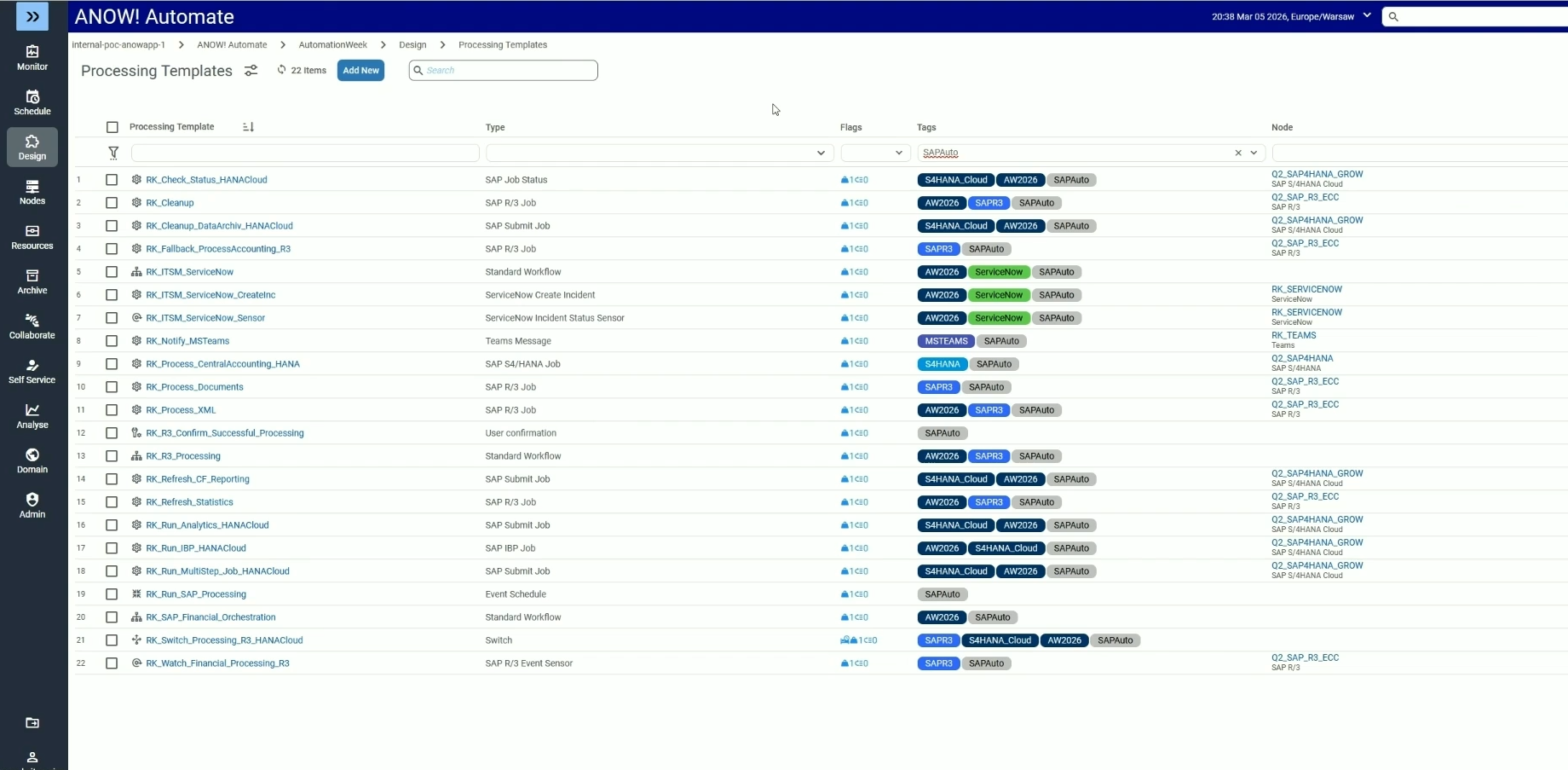
Our SAP orchestration solutions page shows how ANOW! Automate runs SAP jobs from R/3 and ECC through S/4HANA, SAP BTP, and RISE with SAP, alongside the non-SAP systems around them.
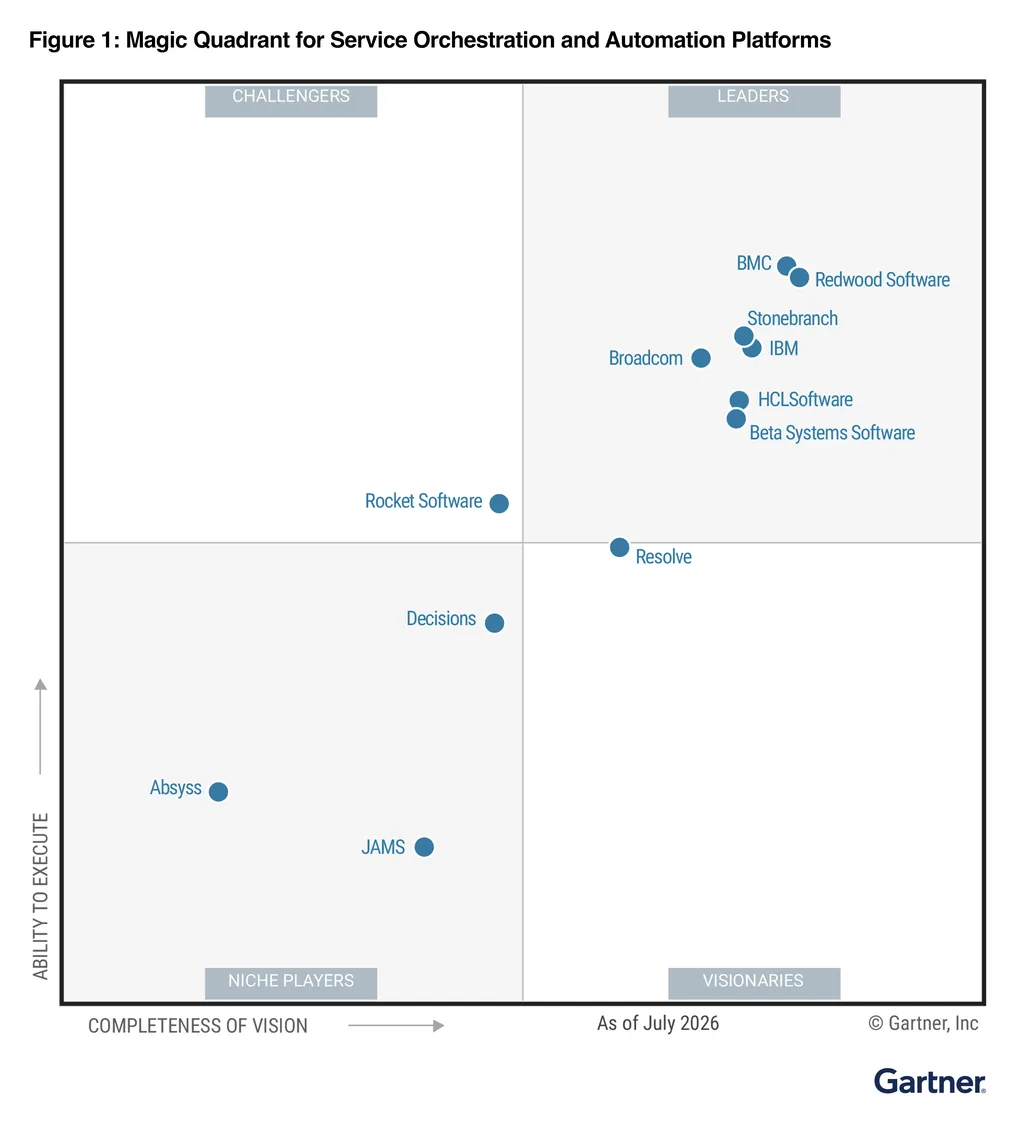
Beta Systems Software is Recognized as a Leader in the 2026 Gartner® Magic Quadrant™
Discover why analysts trust Beta Systems to deliver enterprise-grade workload automation and observability at scale.
For teams also modernizing legacy scheduling alongside SAP middleware, our guide to Broadcom Automic migration and coverage of community-maintained frameworks like Apache Airflow cover the adjacent territory.
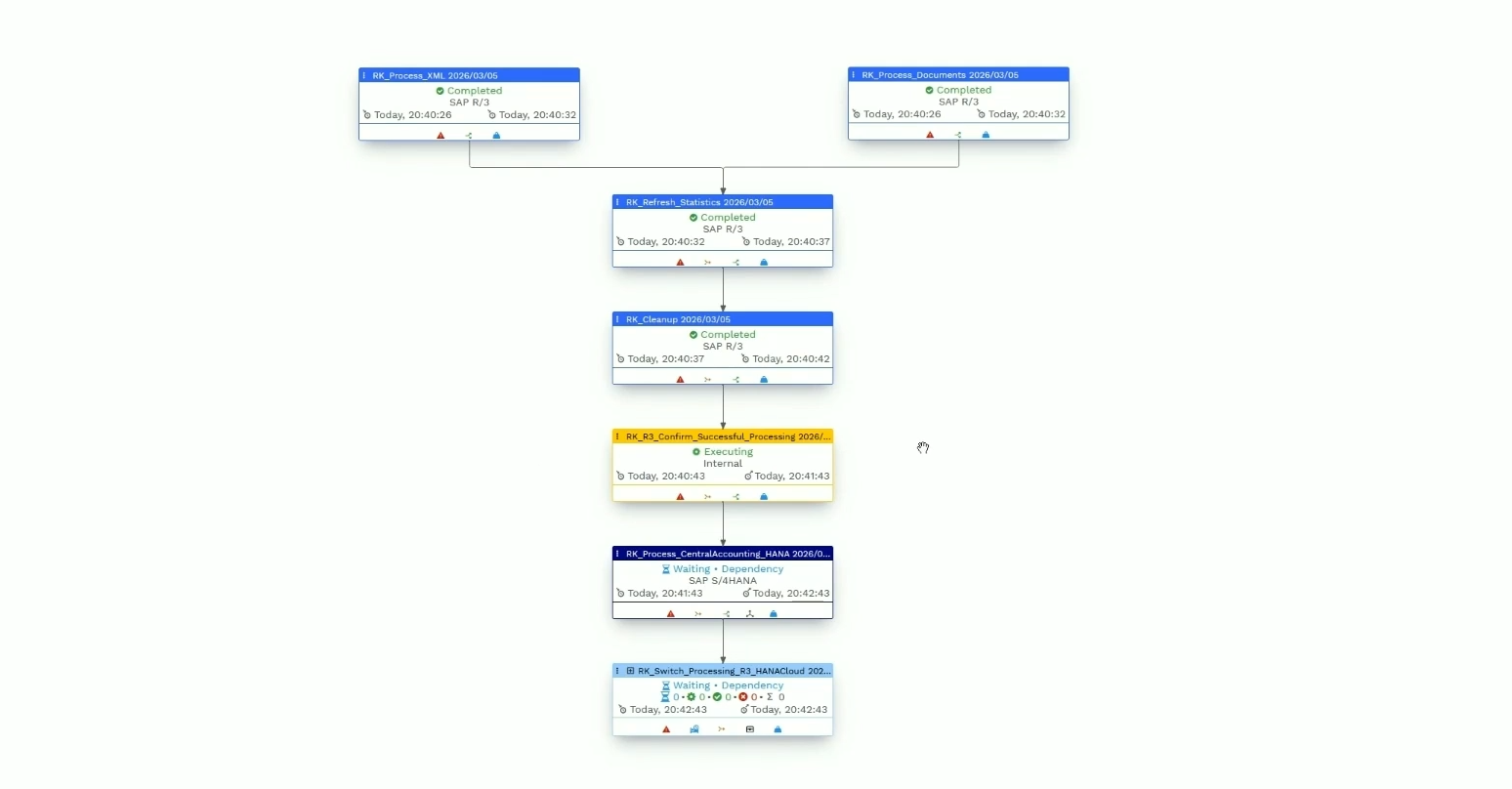
The result is a single control plane for orchestrating SAP jobs alongside everything running around them, rather than treating SAP integration and enterprise-wide job orchestration as two separate problems requiring two separate tools.
Still Running SAP Process Orchestration? Beta Systems Has Your Next Step
If PO is still central to how your SAP jobs and integrations run today, the practical next move is an integration inventory: know what’s running on PO before deciding what moves to Integration Suite, what gets re-architected onto a dedicated orchestration platform, and what can wait out the extended maintenance window.
Beta Systems’s ANOW!® Automate for SAP job scheduling is also listed on the official SAP Store, alongside other vendors in the category, giving you a direct point of comparison. Book a demo with your PO inventory in hand.
FAQs
1. Is SAP Process Orchestration end of life?
Yes, standard maintenance ends December 31, 2027. SAP offers paid extended maintenance through 2030, but it won't receive new features or standard support after the initial deadline.
2. How much does SAP Process Orchestration cost?
SAP PO doesn't carry a separate license fee for existing NetWeaver customers; it's typically bundled into existing SAP licensing. Extended maintenance after 2027 costs extra, and SAP hasn't published a flat public rate because it varies by contract.
3. What is the best alternative to SAP PO after end of maintenance?
It depends on the problem you're solving. For pure SAP integration and API management, SAP Integration Suite is SAP's own recommended path. For coordinating SAP jobs alongside your broader hybrid IT estate, a dedicated workload automation and orchestration platform often fits better than treating integration middleware as a job scheduler.
4. What is SAP BTP orchestration and how does it differ from SAP PO?
SAP BTP orchestration generally refers to Integration Suite (for system integration) or the Orchestration Service inside SAP AI Core (for coordinating generative AI workflows), both running on SAP Business Technology Platform. SAP PO is separate, on-premise NetWeaver middleware being phased out in favor of these cloud-native BTP services.
5. Does SAP Integration Suite replace SAP PO for job scheduling and workload automation?
No. Integration Suite is built for system-to-system integration and API management, not for job scheduling, dependency management, or cross-platform workload orchestration. Organizations using PO as a de facto scheduler typically need a dedicated workload automation platform alongside Integration Suite.