:quality(50))
What is Enterprise Job Scheduling Software?
Enterprise job scheduling software automates, sequences, and monitors the batch jobs and workflows that keep IT operations running from mainframe processes to cloud data pipelines.
Unlike a basic cron job or task scheduler, enterprise-grade platforms manage dependencies between systems, trigger workflows based on events (not just fixed times), and provide centralized visibility across hybrid environments.
Gartner groups the modern version of this category under service orchestration and automation platforms (SOAP); solutions that unify workload automation, workflow orchestration, resource provisioning, and data pipeline management in a single control layer.
According to Gartner’s SOAP market data, the category grew once again YoY with revenue reaching $4.3 billion in 2025 and this is expected to continue to increase to an estimated $4.9 billion by 2028. The compound annual growth rate? 7.7%.
Benefits of a modern enterprise job scheduling platform include:
Centralized control across mainframe, on-premises, and multi-cloud environments
Event-driven automation that responds to real-time triggers instead of fixed clocks
Reduced manual intervention and fewer missed SLAs through dependency-aware workflows
End-to-end visibility into job execution, errors, and performance
Compliance support through audit trails and detailed reporting, which is increasingly important under regulations like DORA
Pro-Tip:
If your team still calls this “batch scheduling,” it’s worth reframing the search. Most legacy schedulers only handle time-based triggers; modern SOAP platforms add event-driven logic, data pipeline orchestration, and (increasingly) GenAI-assisted troubleshooting (capabilities Gartner expects 75% of SOAP workflows to use by 2029, up from under 10% in 2025.)
5 Best Enterprise Job Scheduling Software: A Quick Overview
| Best For | Standout Features | |
|---|---|---|---|
Beta Systems ANOW! Suite | Enterprises replacing legacy WLA with a sovereign, modern platform | 500+ native integrations with Infinite Integration extensibility | |
BMC Control-M | Organizations already standardized on BMC | Jett, BMC's GenAI advisor for workflow troubleshooting | |
Broadcom AutoSys | Large Broadcom/CA-standardized shops | High-volume, script-agnostic batch scheduling | |
Stonebranch UAC | Teams wanting a modern, low-code alternative | Universal Portal for citizen-automator self-service | |
Redwood RunMyJobs | SAP-heavy enterprises comfortable with SaaS-only | Redwood Insights, AI-powered SLA prediction |
Beta Systems: Best for Enterprise Job Scheduling and Automation
Beta Systems is recognized as a Leader in Gartner's 2026 Magic Quadrant for Service Orchestration and Automation Platforms, and its ANOW! Suite is purpose-built for enterprises modernizing away from legacy schedulers.
Not only does Beta Systems provide the benefit of vast breadth in coverage, but it also provides the combination of European data sovereignty, deployment portability (SaaS, private cloud, or on-premises, with the ability to switch without disruption), and a customer retention rate Gartner notes is higher than most other Leaders in the category.
Beta Systems’ ANOW! Suite Key Features
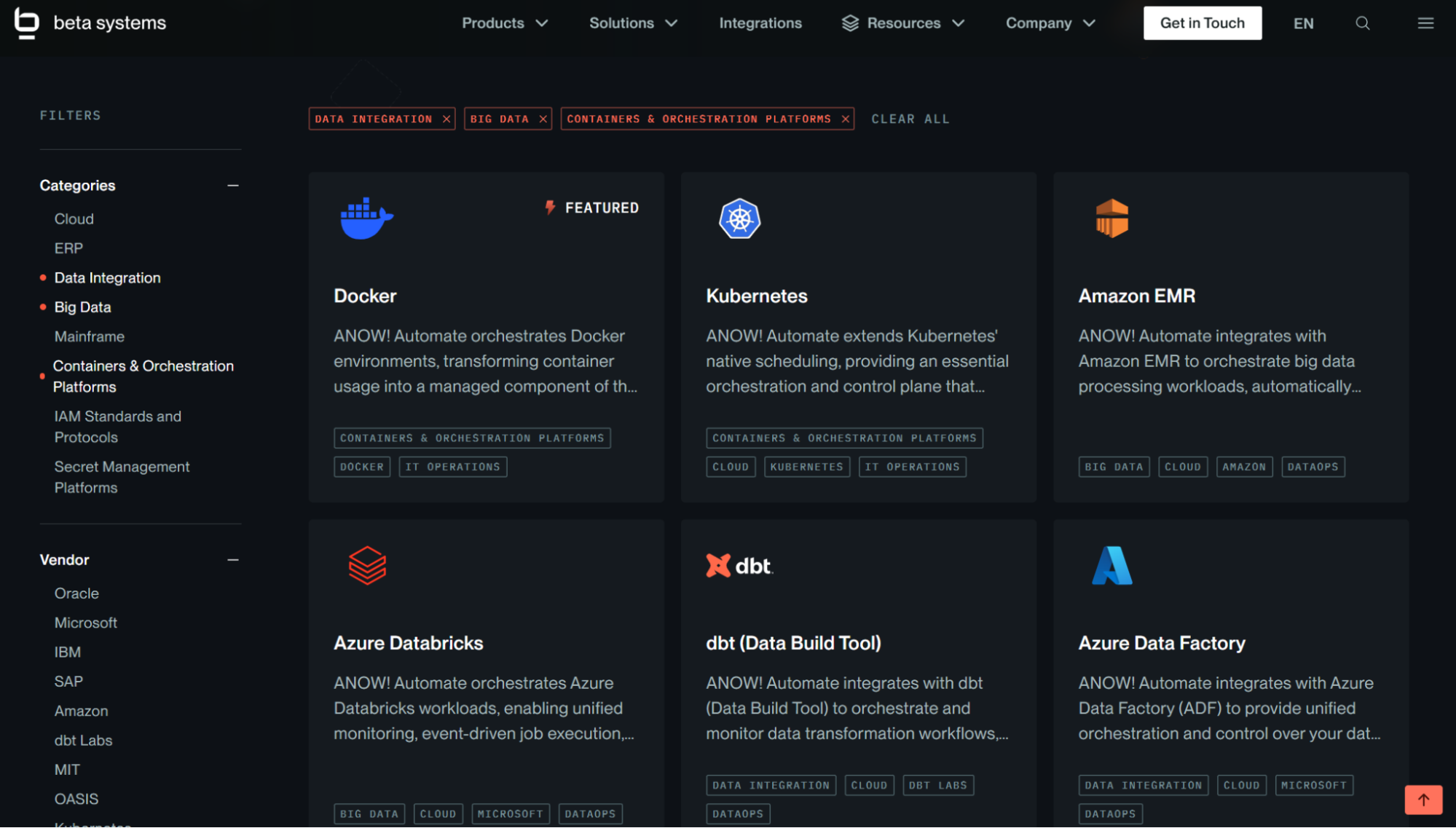
500+ Native Integrations with Infinite Integration Capability
ANOW! Automate connects to over 500 systems out of the box, spanning cloud platforms, databases, ERP, containers, and legacy schedulers. Its Infinite Integration architecture lets teams build custom connectors via API, CLI, or JavaScript for anything outside the standard library.
Native Full-Stack Observability
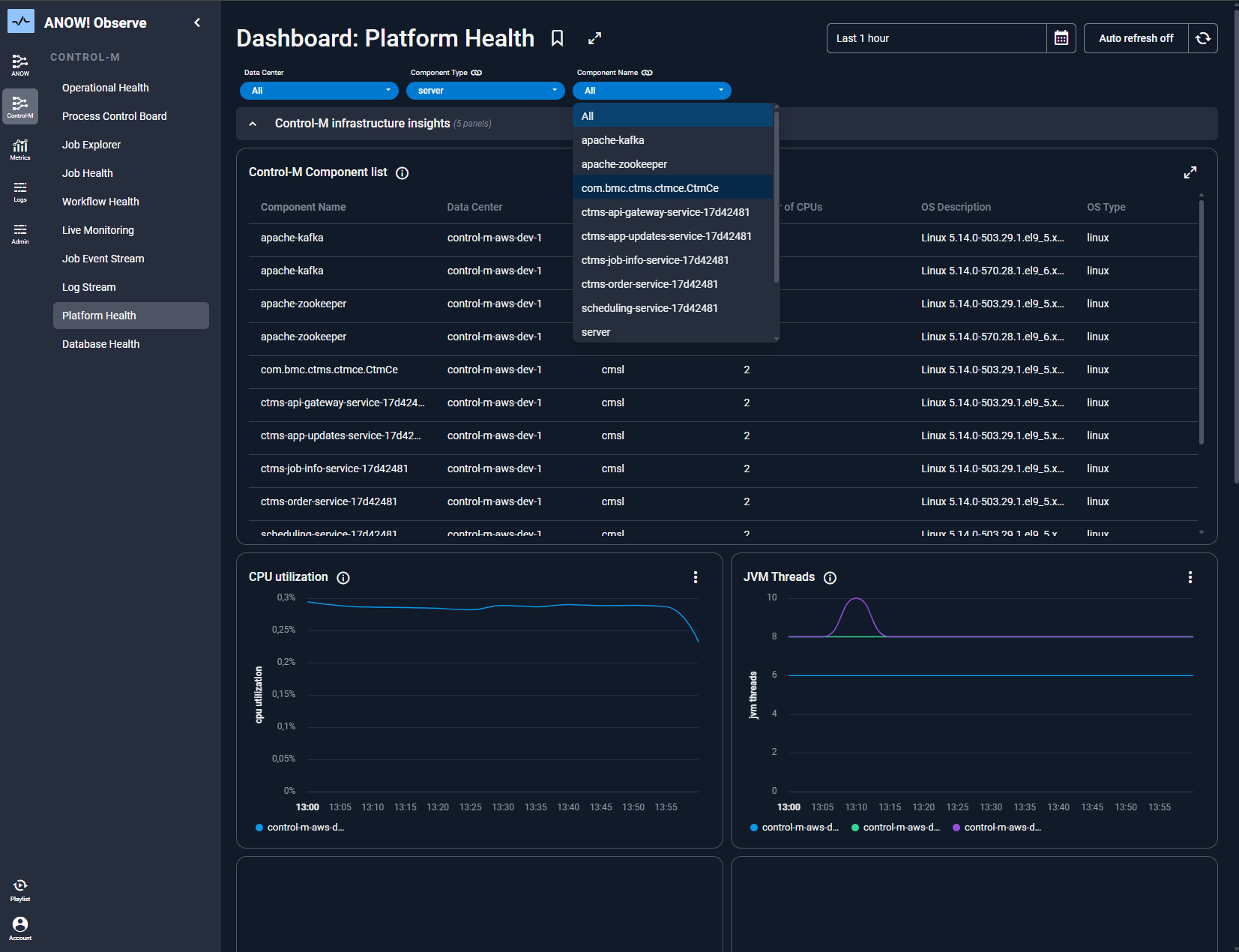
Through ANOW! Observe, the platform embeds OpenTelemetry-native observability directly into orchestration workflows, emitting real-time metrics, logs, and traces that power anomaly detection, SLA-risk forecasting, and automated remediation.
Enterprise-Grade SAP Orchestration
ANOW! Automate provides native, bidirectional orchestration across SAP S/4HANA (both GROW and RISE editions), S/4HANA Cloud and SAP ERP. This is a priority for manufacturing, retail, and BFSI enterprises running ERP-heavy workloads alongside non-SAP systems.
Where Beta Systems’ ANOW! Suite Shines
European data sovereignty: Backed by a European vendor with ISO 27001-compliant infrastructure and compliance tooling aligned to GDPR and DORA; this is a differentiator for BFSI and manufacturing enterprises with strict residency requirements.
No vendor lock-in: ANOW! runs identically across SaaS, private cloud, and on-premises, and organizations can switch deployment models without re-architecting.
Proven vendor viability: Gartner notes Beta Systems has endured multiple technology cycles over four decades and has above-average customer retention among Leaders, particularly in finance, government, and insurance.
Beta Systems Software is Recognized as a Leader in the 2026 Gartner® Magic Quadrant™
Discover why analysts trust Beta Systems to deliver enterprise-grade workload automation and observability at scale.
:quality(80))
Where Beta Systems’ ANOW! Suite Falls Short
AI capabilities are still maturing: Beyond its AI-powered PII filtering, ANOW! doesn’t yet offer the kind of conversational GenAI troubleshooting assistant that BMC (Jett) or Redwood (Redwood Insights) have shipped, a gap Beta Systems will need to close as GenAI becomes a standard SOAP feature.
Limited brand recognition outside Europe: Gartner notes Beta Systems’ customer base is concentrated in Europe, with a heavier reliance on direct sales than global systems-integrator partnerships. Enterprises evaluating from North America or Asia-Pacific should factor this into due diligence.
Customer Reviews
A verified user commends the platform, saying, “I use ANOW! Suite as a centralized platform to manage and streamline my daily workflows. It helps me organize tasks, track progress, and maintain better visibility across ongoing activities. What I like most about ANOW! Suite is its ability to bring everything into one centralized platform. It makes task management and tracking very intuitive, improves visibility across workflows, and helps me stay organized.”
Another user shares, “I really like that everything is in one place. It gives me a “single point of control” for all my tasks and workflows, which makes it much easier to see what is happening in real-time.”
Who Beta Systems’ ANOW! Suite is Best For
European enterprises with data sovereignty requirements, especially BFSI and manufacturing organizations subject to DORA or similar regulation.
Organizations replacing BMC Control-M, Broadcom AutoSys, or Redwood as ANOW!’s zero-touch migration tooling is built specifically for this transition.
CDOs and data platform leaders who need multi-cloud data pipeline orchestration alongside traditional workload automation, not two separate tools.
See how ANOW! Automate handles legacy scheduler migration
Find out how zero-touch migration and 500+ native integrations can help move complex workloads off legacy schedulers without rebuilding your automation estate from scratch.
BMC Control-M: Best for Enterprises Already Standardized on BMC
BMC Control-M is the most widely deployed enterprise job scheduler on the market and remains a Leader in Gartner’s 2026 Magic Quadrant. It orchestrates mainframe, multicloud, and AI/ML DataOps pipelines through a single “Unified View” interface, and BMC continues investing in jobs-as-code and LLM ecosystem integration.
One important update for anyone evaluating Control-M in 2026 to consider is that in April 2025, BMC split into two independent companies (BMC and BMC Helix) and in June 2026, BMC Helix was acquired by Montagu, meaning it no longer shares ownership with BMC Software. Customers may have concerns about support continuity and long-term integration between products that now sit under separate corporate structures.
Key Features
Jett, BMC’s GenAI advisor: Embedded directly in Control-M, Jett lets users ask natural-language questions about workflows and assists with anomaly detection and compliance checks.
Unified View: A single interface for building, running, and managing workloads across self-hosted and SaaS deployments.
Broad ecosystem coverage: Deep support for mainframe-to-multicloud orchestration backed by a large global partner and VAR network.
Where Control-M Shines
GenAI features: Deepest bench of enterprise-grade GenAI tooling among legacy vendors via Jett
Extensive network: Extensive professional services and partner network for large, complex migrations
Where Control-M Falls Short
High total cost of ownership: Licensing plus the personnel cost of skilled Control-M administrators can be difficult to justify outside large, complex deployments.
Post-split uncertainty: The 2025 BMC/BMC Helix separation, followed by Helix’s 2026 acquisition by Montagu, has introduced real ambiguity for customers relying on products that now span two independently owned companies.
Customer Reviews
Shaik A. praises, “What I like best about Control-M is its powerful automation and centralized workflow management. It allows me to schedule, monitor, and manage jobs across multiple systems from a single interface, which makes operations much easier and more efficient.”
Indranil S. flags, “The reporting tool still needs a lot of improvement. It was supposed to get better with the upgrade, and it really didn't get better. It needs help, because it's such a useful thing to have. It needs to be more powerful and easier to use.”
Who Control-M is Best For
Enterprises already standardized on BMC where switching costs and retraining would outweigh the benefits of moving elsewhere.
Organizations needing proven mainframe-to-multicloud breadth, backed by an established global support and VAR network.
Teams that can absorb higher TCO in exchange for one of the most mature GenAI feature sets in the category.
→ See how ANOW! compares directly to Control-M
Broadcom AutoSys: Best for Broadcom-Standardized Enterprises
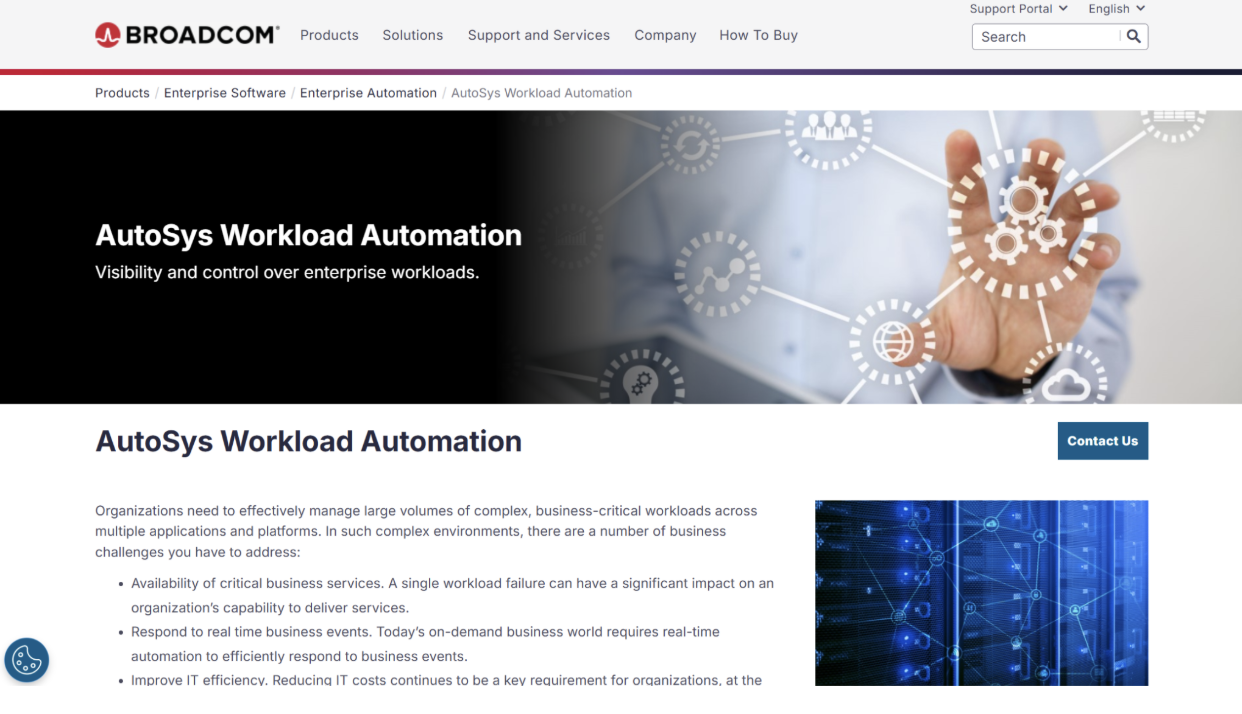
Broadcom AutoSys is one of the most widely deployed legacy job schedulers in enterprise IT, particularly in BFSI and manufacturing. It's worth noting that AutoSys and Broadcom's other SOAP offering, Automic Automation, are separate products despite shared ownership;
Automic Automation is often seen as Broadcom’s Leader-tier entry, while AutoSys serves a distinct, more legacy-oriented segment of Broadcom's automation portfolio.
Key Features
Cross-platform batch scheduling: Manages thousands of jobs across mixed server environments, including legacy on-premises systems and VMs.
Script-agnostic administration: Long-standing support for CLI-based job control, which reduces friction for teams with deep existing AutoSys scripting expertise.
Broadcom ecosystem integration: Interoperates with other Broadcom/CA portfolio tools for organizations standardized on that stack.
Where AutoSys Shines
Stability at high job volumes: Proven reliability managing large batch workloads on established infrastructure.
Deep Broadcom interoperability: A natural fit for enterprises already standardized on multiple Broadcom products.
Where AutoSys Falls Short
CLI-heavy administration: AutoSys’s reliance on command-line interfaces adds operational overhead compared to the low-code, browser-based UIs most modern competitors now offer.
Slower pace of modernization: Search interest in AutoSys has been declining, and some reviewers cite a comparatively limited feature set against newer entrants, which is a reasonable proxy for reduced ongoing investment relative to the rest of the category.
Customer Reviews
Gaurav G. praises, “Autosys is a solid, dependable scheduler for large enterprise environments. It handles complex dependencies well, and once you get comfortable with its structure, managing jobs becomes fairly straightforward.”
Rupali M. notes, “Session logout pop-up doesn't allow you to continue with the session even though you select the timer pop-up. Not all job details can be accessed in descriptive form from a single selection of box name.”
Who AutoSys is Best For
Large Broadcom/CA-standardized enterprises that need dependable, high-volume batch scheduling without an immediate platform change
BFSI and manufacturing shops with deep CLI scripting investment where the migration cost of leaving CLI-based workflows currently outweighs the benefit.
→ Explore what a modern AutoSys replacement looks like
Stonebranch UAC: Low-Code Alternative to Legacy Schedulers
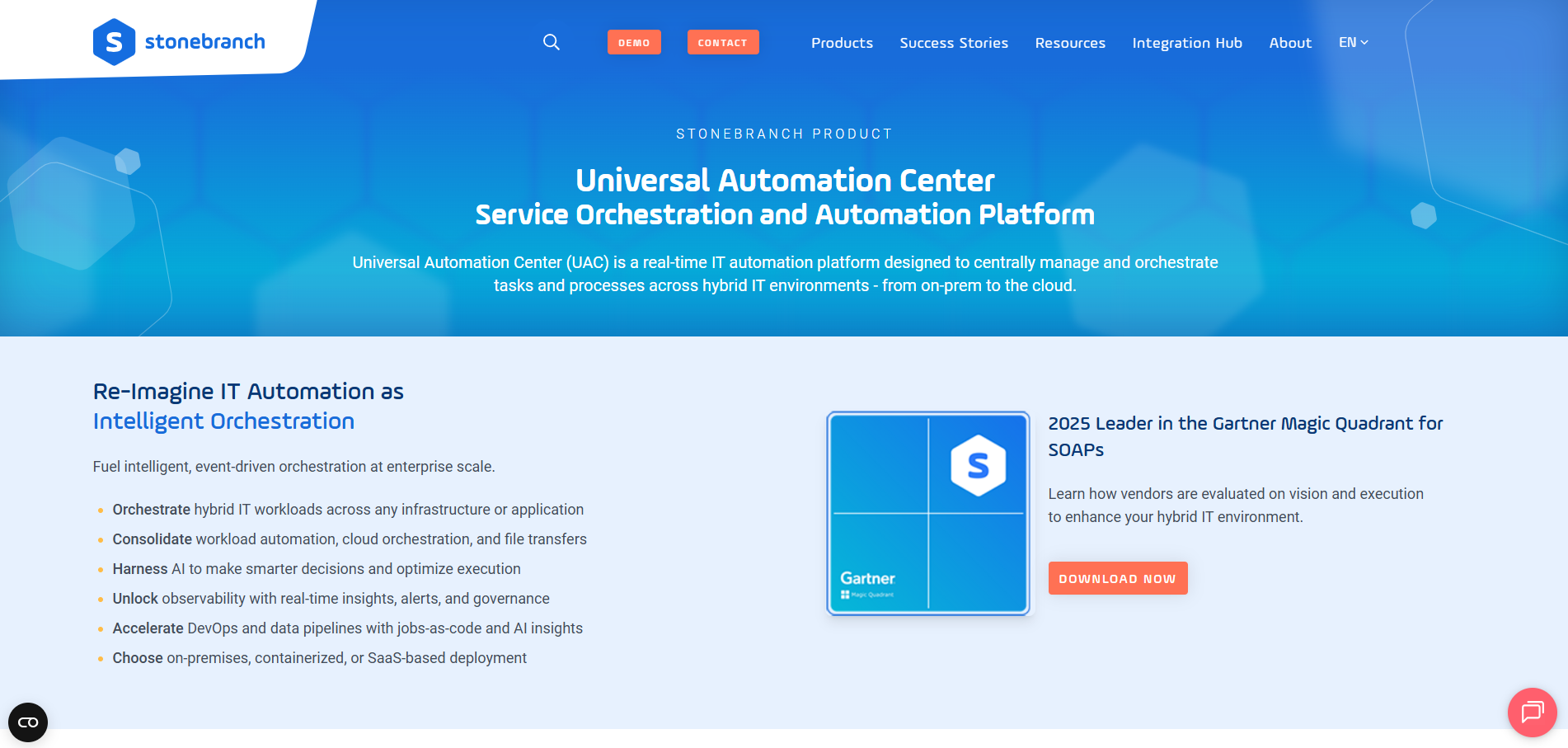
Stonebranch is widely regarded as one of the most credible modern alternatives in this category. Its Universal Automation Center (UAC) can be deployed self-hosted or as SaaS, and in 2025 Stonebranch launched its Universal Portal for self-service automation across skill levels.
Key Features
Data Pipeline Orchestration: A dedicated, purpose-built module for managing complex data pipelines across the modern data stack (Snowflake, Databricks, dbt).
Low-code, drag-and-drop workflow designer: Gartner notes this enables non-developers to build complex automations without scripting.
Universal Portal: Self-service automation for citizen automators across devices and skill levels, launched in 2025.
Where Stonebranch Shines
Intuitive, modern UI: Consistently praised in customer feedback for its web-based interface and low-code designer.
Strong migration services: Expert-led migration support that customers report using successfully to transition from legacy SOAP platforms.
Where Stonebranch Falls Short
AI capabilities lag category Leaders: Gartner notes Stonebranch's early-access "Robi AI" is currently limited to documentation, task definitions, and reports, behind the troubleshooting-focused GenAI assistants other Leaders now offer.
No self-service trial: The sales-led PoC requirement can slow bottom-up, developer-led evaluation compared to platforms with instant access.
Customer Reviews
Vinothkumar M. mentions, “The most valuable feature of the Stonebranch Universal Automation Center (UAC) is its superior scheduling and cross-platform integration capabilities, which have fundamentally transformed how we orchestrate our ETL workflows. Now, we have centralized, end-to-end control over every ETL job.”
Stephen E. flags, “My main issue was the setup process. Even though the knowledge base includes a lot of information, it can be a bit hard to navigate at times. There are definitely sections where, if you miss a step or overlook a detail, you can end up stuck and unsure what to do next.”
Who Stonebranch is Best For
Teams that want a modern, low-code alternative without requiring the deeper mainframe and SAP orchestration depth Beta Systems offers
Organizations without strict EU data-sovereignty requirements, as Stonebranch’s customer base and go-to-market are less Europe-concentrated than Beta Systems’
Redwood RunMyJobs: Best for SAP-Heavy Enterprises
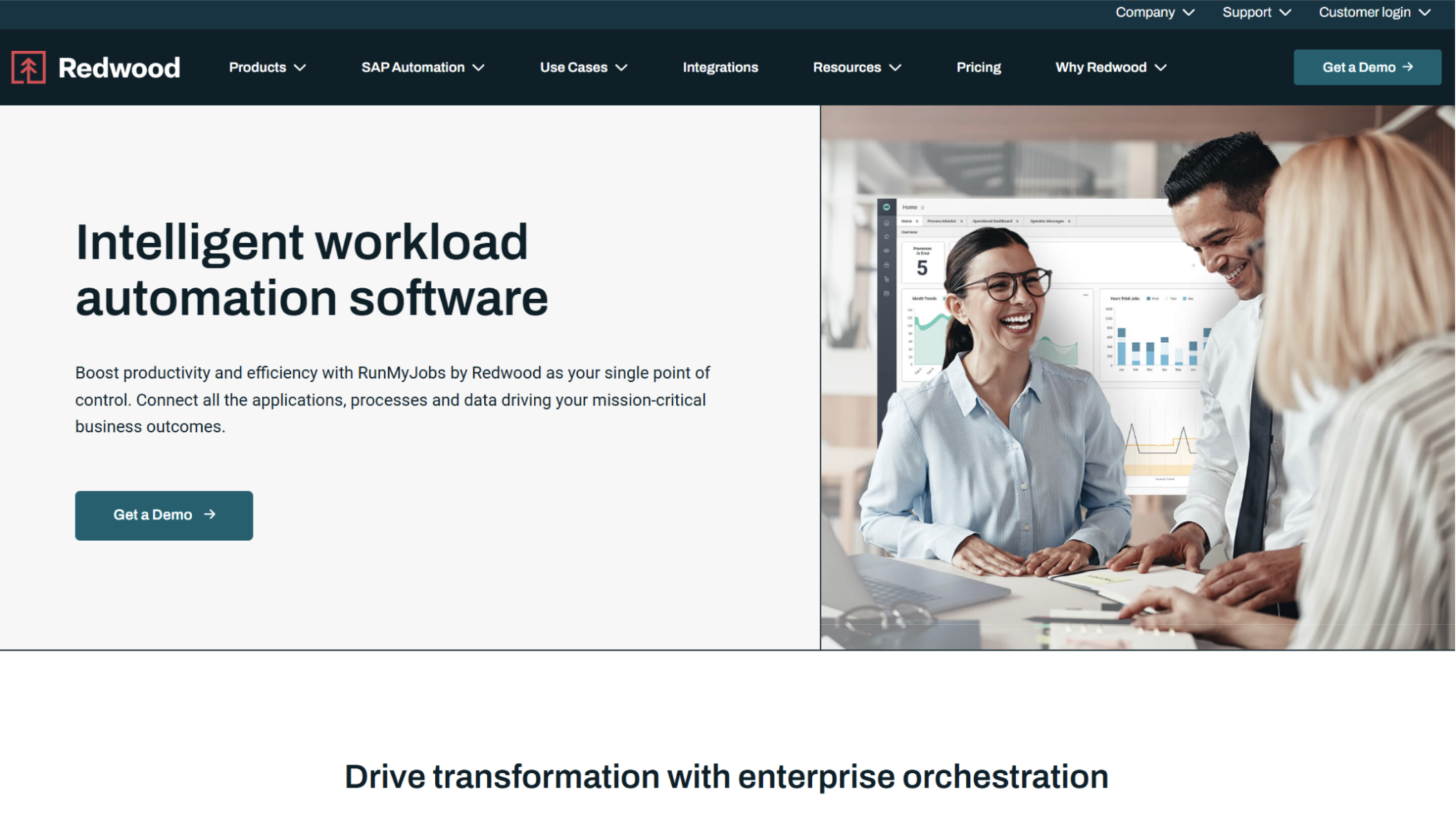
Redwood Software’s RunMyJobs is the strongest SAP-native scheduler in the category, making it especially relevant for manufacturing, BFSI, and retail organizations running RISE or GROW with SAP S/4HANA. Redwood also introduced Redwood Insights, an AI-powered observability layer, in 2025.
Key Features
Deep SAP integration: Extensive native connectors for complex ERP processes, curated based on customer demand.
Redwood Insights: An AI assistant that analyzes performance, predicts potential SLA misses, and generates plain-language explanations of process behavior.
Low-code, drag-and-drop editor: Gartner customers rate the visual workflow builder highly for enabling both IT and business-analyst users to build automations.
Where RunMyJobs Shines
Best-in-class SAP orchestration: The strongest native SAP integration depth among the platforms in this list.
Strong satisfaction scores: RunMyJobs consistently rates among the highest on G2 for ease of use and a strong admin experience.
Where RunMyJobs Falls Short
SaaS-first, multitenant deployment: Gartner notes this model isn’t well suited for organizations in highly regulated industries with strict data sovereignty rules. However, on-premises and private cloud options are available.
Renewal pricing concerns: Gartner customers have reported frustration with cost increases during renewal negotiations, which is worth flagging explicitly in any RFP.
Customer Reviews
Vandana S. praises, “I've been using RunMyjob Tool for a while now and I'm genuinely impressed with how smooth and efficient it makes managing tasks. The interface is clean, user- friendly and easy to navigate, even for those who are new to this tool.”
Srinivas T. notes a few cons, listing cost, complexity, customization, and reporting as lacking. “Perceived as expensive, with some feeling the features don't justify the price, especially for smaller companies,” he shares, adding, “Customization is challenging, with reports of bugs and poorly developed connectors hindering usability.”
Who RunMyJobs is Best For
SAP-heavy enterprises, particularly those running RISE or GROW with SAP S/4HANA, who prioritize native SAP certification.
Organizations comfortable with SaaS-only deployment where data residency isn’t a blocking requirement.
How to Choose an Enterprise Job Scheduling Software
The right platform depends on what you’re actually replacing and what constraints your industry imposes. Here’s what to weigh before you shortlist.
Hybrid and Mainframe-to-Cloud Coverage
If your organization still runs mission-critical mainframe workloads alongside cloud services, confirm the platform can orchestrate both from a single control plane rather than requiring separate tools.
This is where ANOW! Automate's single point of control across mainframe, on-premises, and multi-cloud environments becomes a practical advantage rather than a marketing claim.
Observability and AI-Readiness
Gartner projects that by 2029, 75% of SOAP workflows will use GenAI to improve troubleshooting efficiency by 50%, up from under 10% in 2025.
Ask vendors directly what’s shipping today versus what’s on the roadmap, and whether observability is a bolt-on or a native part of the orchestration engine, as it is with ANOW! Observe.
Data Sovereignty and Compliance
For BFSI, insurance, and manufacturing organizations in the EU, data residency and frameworks like DORA are no longer optional line items.
Beta Systems’ European ownership and ISO 27001-compliant infrastructure are built specifically around this requirement. This is worth a closer look if your evaluation includes a SaaS-only vendor by default.
Integration Breadth and Vendor Lock-in
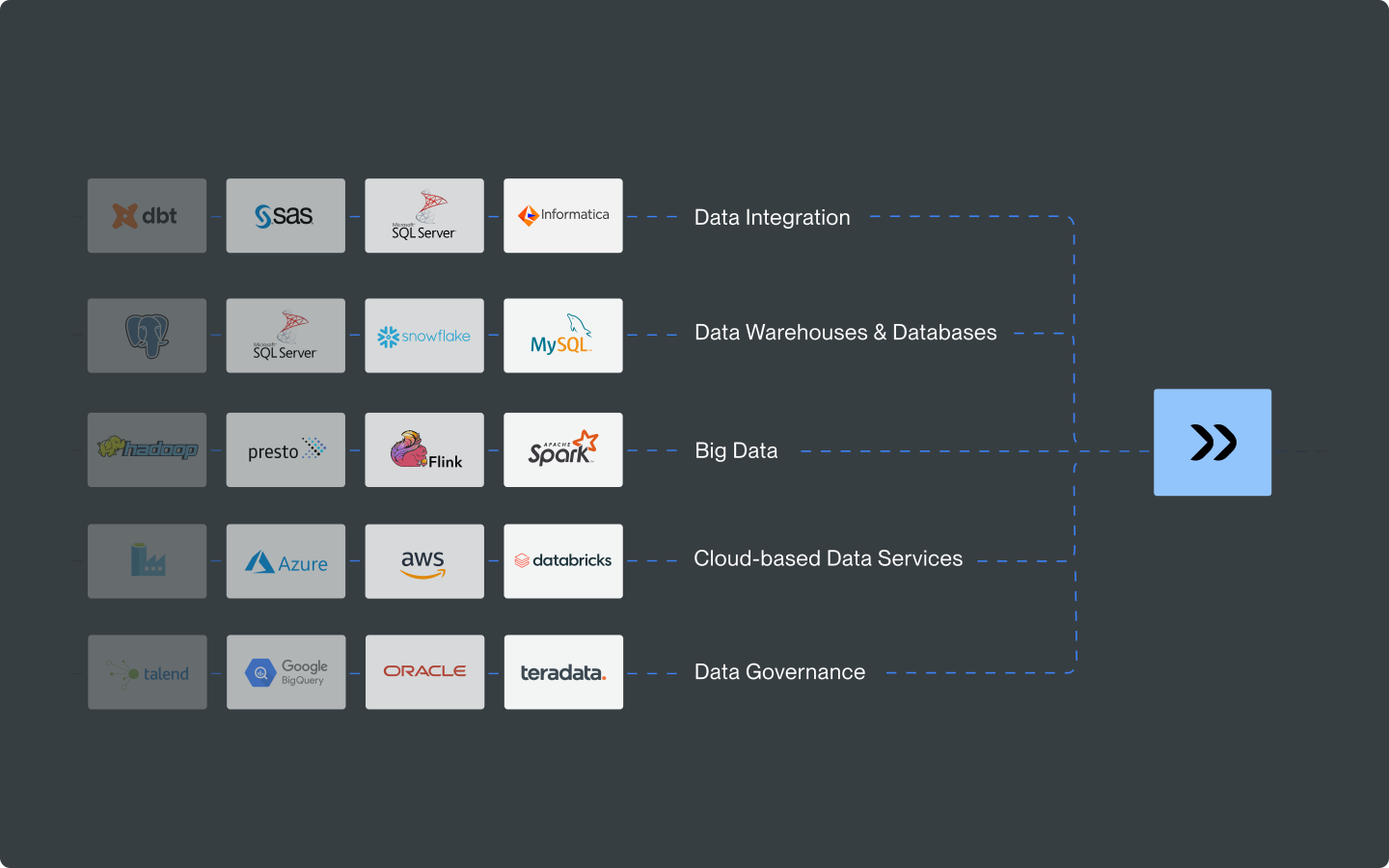
Count how many of your existing systems the platform supports natively versus how many will require custom scripting or middleware.
ANOW! Automate’s 500+ native connectors and Infinite Integration extensibility framework are designed to reduce that custom-build burden as your stack evolves.

Integration Architecture
Discover Your Integration Possibilities
Connect your Beta Systems platform with the enterprise applications, APIs, and services that you already use. Streamline data exchange and orchestrate end-to-end workflows across your IT landscape.
Modernize Your Enterprise Job Scheduling with Beta Systems
Every platform on this list can schedule a job. The real differences show up when your environment gets more complicated: more clouds, more compliance requirements, more pressure to reduce reliance on any single vendor.
If that describes where your organization is headed, Beta Systems' ANOW! Suite is built specifically for enterprises making that transition, with the European data sovereignty and integration depth that legacy schedulers weren’t designed to offer.
If you’re still narrowing your shortlist, talk to our team directly to scope your specific environment.
Talk to Beta Systems about your scheduling environment
If you’re still narrowing your shortlist, talk to our team directly to scope your specific environment
Frequently Asked Questions
1. What is an enterprise scheduler?
An enterprise scheduler is software that automates, sequences, and monitors batch jobs and workflows across an organization's IT systems (mainframe, on-premises, and cloud). Unlike basic time-based tools like cron, enterprise schedulers manage dependencies between systems, trigger workflows based on real-time events, and provide centralized visibility and audit trails across hybrid environments at scale.
2. Which enterprise job scheduling software is best?
It depends on what you’re replacing. For most enterprises modernizing off a legacy platform, Beta Systems' ANOW! Suite is the strongest overall pick as it offers 500+ native integrations, no vendor lock-in, and full European data sovereignty. BMC Control-M suits organizations already standardized on BMC, Redwood RunMyJobs is strongest for SAP-heavy environments, and Stonebranch UAC is the closest modern alternative for teams without strict EU data-residency needs.
3. How long does an enterprise job scheduler migration typically take?
It varies significantly by environment complexity, but large enterprise migrations typically run from several months to over a year when mainframe and multi-system dependencies are involved. Platforms with dedicated migration tooling and services (rather than a DIY approach) generally reduce both timeline and risk.
:quality(50))
:quality(50))
:quality(50))