:quality(50))
We've reviewed the 5 platforms that genuinely compete at enterprise scale, covering features, where each tool shines, and where it falls short.
Keep reading to learn more about what hybrid cloud orchestration is, why it’s difficult to get right at enterprise scale, how it works in practice, and which platforms are built to handle it.
What is an Automation Orchestration Platform?
An automation orchestration platform coordinates and manages the execution of complex, dependent workloads across systems, applications, and infrastructure — on-premises, in the cloud, or both.
Unlike basic schedulers that run jobs on a time trigger, orchestration platforms manage conditional dependencies, handle failures intelligently, and provide real-time visibility across the full workflow lifecycle.
The key benefits of this kind of workload automation and orchestration are:
Unified control across hybrid and multi-cloud environments
Event-driven and dependency-based scheduling (not just time-based)
End-to-end data pipeline orchestration — from ingestion to analytics
SLA monitoring, alerting, and automated remediation
Integration with DevOps toolchains, SAP, ITSM, and cloud-native services
Compliance, audit trails, and governance at scale
5 Best Automation Orchestration Platforms: A Quick Overview
Platform | Best For | Standout Feature | |||
|---|---|---|---|---|---|
|
| 600+ native integrations; deployment portability | |||
|
|
| |||
Broadcom Automic |
| Zero Downtime Upgrade; container-native | |||
Redwood RunMyJobs |
| Drag-and-drop workflow editor; deep SAP integration | |||
Apache Airflow |
| Open-source; DAG-based pipeline orchestration |
1. Beta Systems ANOW! Suite: Best for Enterprise Legacy Replacement
Beta Systems’ ANOW! Suite is a cloud-native workload automation, orchestration, and observability platform built specifically for enterprises moving off legacy vendors like BMC Control-M, Broadcom Automic, and Redwood RunMyJobs. It combines ANOW! Automate (the orchestration engine) and ANOW! Observe (the observability layer) in one unified platform.
Gartner’s 2025 Magic Quadrant for Service Orchestration and Automation Platforms positions Beta Systems as a Leader, citing the platform's product strategy, observability capabilities, and vendor viability.
Key Features
Here are the main features of the ANOW! Suite to know.
600+ Native Out-of-the-Box Integrations
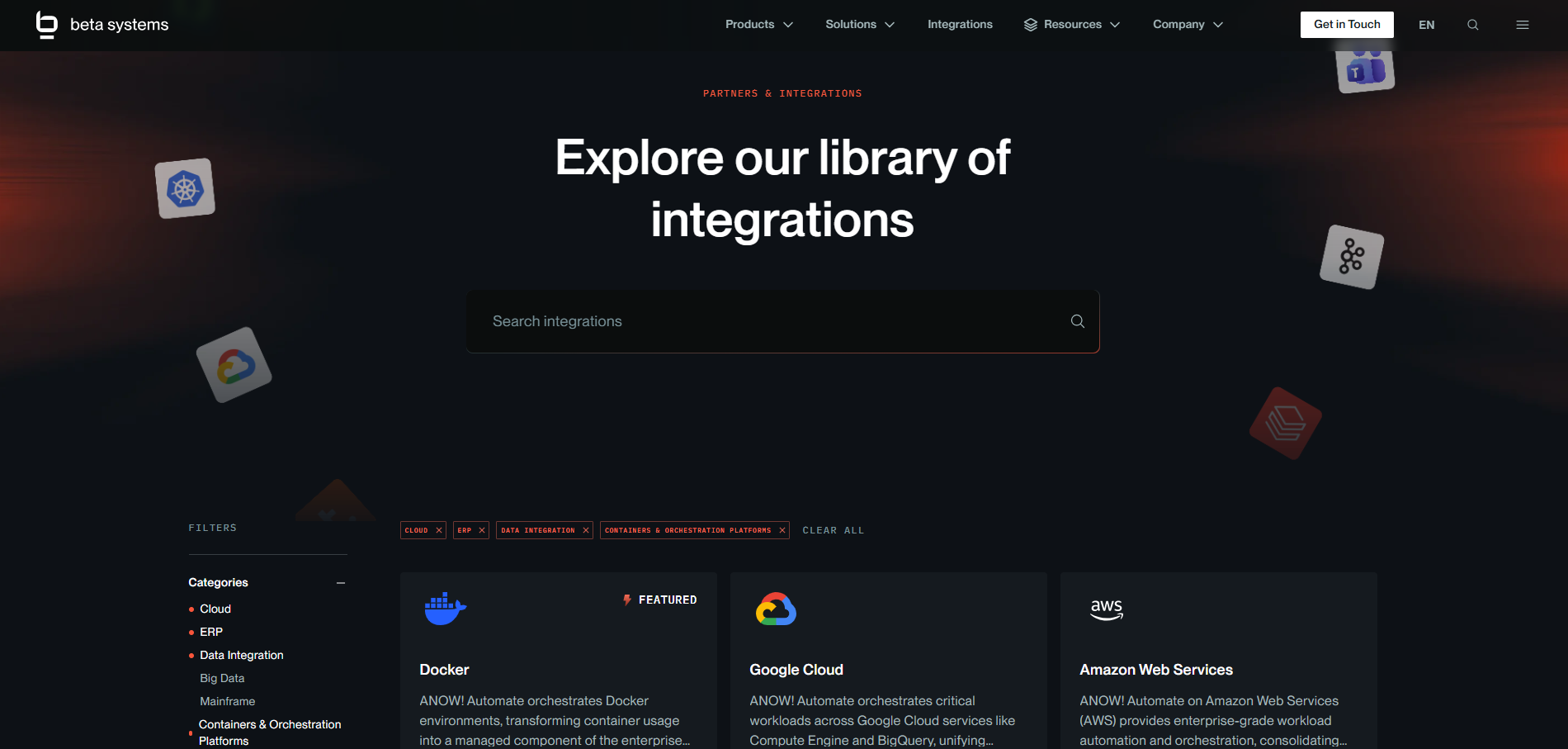
ANOW! Automate ships with over 600 pre-built connectors (more than any other WLA vendor) spanning cloud hyperscalers (AWS, Azure, GCP), DevOps tools (GitHub, GitLab, Azure DevOps), data platforms (Snowflake, Databricks, BigQuery), ERP systems (SAP S/4HANA), ITSM platforms (ServiceNow, Jira), and legacy schedulers.Its Infinite Integration capability extends this further, allowing teams to onboard custom, proprietary, or niche tools via APIs, CLI, scripting, and JavaScript-based integration logic with no connector library limitations.
Deployment Portability: No Lock-In
ANOW! Automate runs identically across SaaS (multitenant or dedicated), private cloud, and on-premises deployments.
Critically, organizations can switch between deployment models at any time without platform disruption, which is a direct counter to the vendor lock-in frustration common among Broadcom and BMC customers. The platform is cloud-agnostic across AWS, Azure, and Google Cloud, backed by a 99.95% availability SLA.
OpenTelemetry-Native Observability
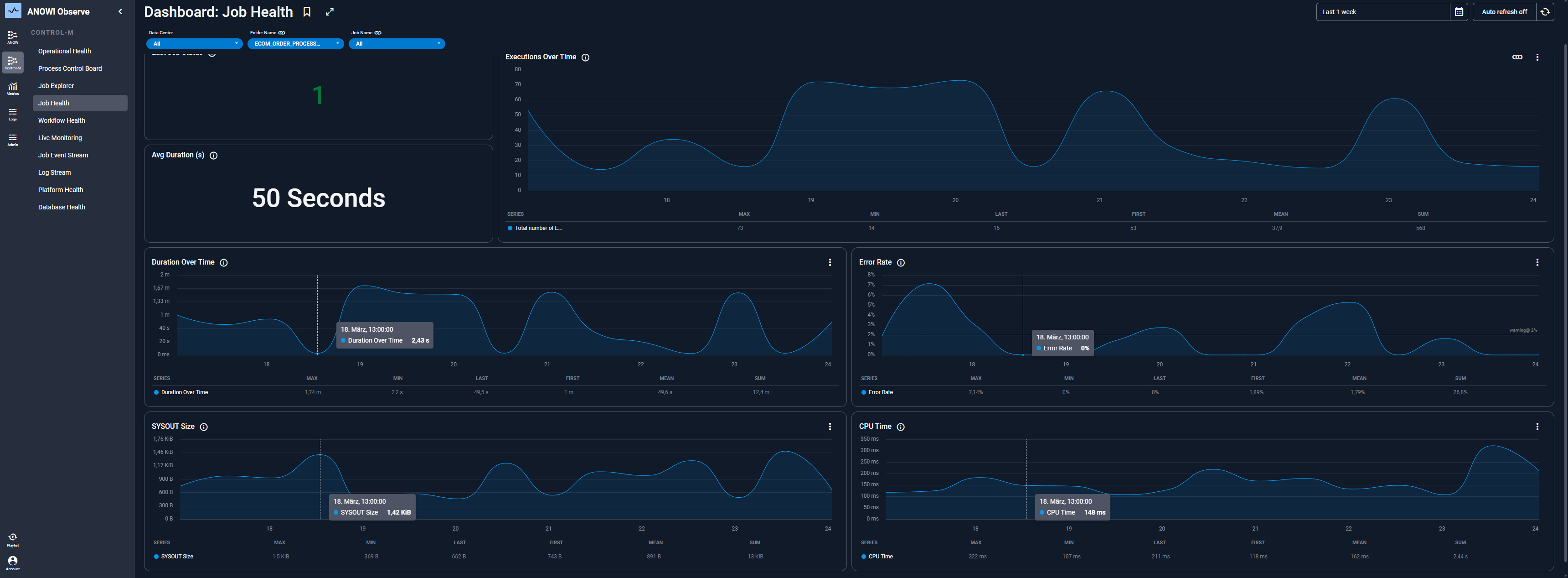
ANOW! Observe embeds OpenTelemetry natively into the orchestration engine, emitting real-time metrics, logs, and traces (MLT) across the entire hybrid IT landscape, giving teams greater visibility into hybrid workload automation.This powers AI-driven anomaly detection, SLA risk forecasting, and automated remediation, closing the loop between monitoring and execution.
Where Beta Systems Shines
Sovereignty and compliance: As a European vendor with ISO 27001-compliant infrastructure, GDPR-ready architecture, and an AI-powered PII filter built into the platform, Beta Systems is the natural choice for European enterprises operating under DORA and similar regulatory frameworks
Zero-downtime migration from legacy vendors: ANOW! Automate's zero-touch migration tooling, container-native Kubernetes architecture, and browser-based interface eliminate the heavy lift typically associated with platform transitions. Beta Systems provides dedicated BMC Control-M replacement and AutoSys replacement pathways
Contextual intelligence: ANOW! Automate's dynamic workflow engine supports multi-level variables, sensor-driven inputs, and computed values, capable of generating hundreds of thousands of unique workflow variants from minimal definitions. This is well beyond what legacy WLA platforms offer
Where Beta Systems Falls Short
UI language coverage: The platform interface is currently available in English, Polish, and German
Brand recognition outside Europe: Gartner notes that Beta Systems' market presence in North America and Asia-Pacific is still developing. Enterprises that rely heavily on global system integrators (GSIs) for procurement may find fewer established channels compared to BMC or Broadcom
Customer Reviews
A verified user shares, “I really like that everything is in one place. It gives me a “single point of control” for all my tasks and workflows, which makes it much easier to see what is happening in real-time.”
Another user praises ANOW’s centralized nature, saying, “It helps me organize tasks, track progress, and maintain better visibility across ongoing activities. What I like most about ANOW! Suite is its ability to bring everything into one centralized platform. It makes task management and tracking very intuitive, improves visibility across workflows, and helps me stay organized.”
Who Beta Systems is Best For
Enterprise IT Operations and I&O leaders evaluating a modern replacement for BMC Control-M, Broadcom Automic/AutoSys, or Redwood RunMyJobs
European enterprises in BFSI, manufacturing, retail, and pharma with data sovereignty or DORA compliance requirements
CDOs and data platform leaders orchestrating complex, cross-cloud data pipelines at scale
2. BMC Control-M: Best for Mainframe-to-Multicloud Environments
BMC Control-M is one of the most widely deployed workload automation platforms in the enterprise market. Its SOAP offering integrates mainframe, multicloud, and AI/ML/DataOps pipelines under a single orchestration view
In April 2025, BMC split into two independent companies: BMC and BMC Helix, something prospective buyers should factor into long-term vendor strategy planning.
Key Features
Unified View: A single interface for building, running, and managing complex workloads across self-hosted and SaaS deployments
Jett GenAI Advisor: An embedded AI assistant for natural language workflow troubleshooting, compliance checks, and anomaly detection
AI/ML/DataOps pipeline orchestration: Native support for data engineering workflows alongside traditional batch job scheduling
Where BMC Control-M Shines
Breadth of mainframe support: Few platforms match Control-M's depth of mainframe integration alongside modern cloud orchestration
Global enterprise support: BMC’s Customer Engagement Model includes professional services for competitive migration and a strong VAR and partner network
Explore more cloud scheduling software for cloud-first workflows.
Where BMC Control-M Falls Short
Total cost of ownership: Gartner notes Control-M’s high TCO is a recurring concern, particularly for organizations with less complex scheduling needs
Post-split uncertainty: Following the BMC/BMC Helix split, customers have expressed concern about long-term support and integration continuity across both entities
Customer Reviews
Shaik A. praises, “What I like best about Control-M is its powerful automation and centralized workflow management. It allows me to schedule, monitor, and manage jobs across multiple systems from a single interface, which makes operations much easier and more efficient.”
Indranil S. warns, “The reporting tool still needs a lot of improvement. It was supposed to get better with the upgrade, and it really didn't get better. It needs help, because it's such a useful thing to have. It needs to be more powerful and easier to use.”
Who BMC Control-M Is Best For
Large enterprises with deep mainframe investment that need mainframe-to-multicloud orchestration continuity
Organizations with established BMC partner relationships and access to skilled Control-M administrators
If you’re evaluating alternatives to Control-M, read more on BMC Control-M replacement options.
3. Broadcom Automic Automation: Best for Enterprises on the Broadcom Stack
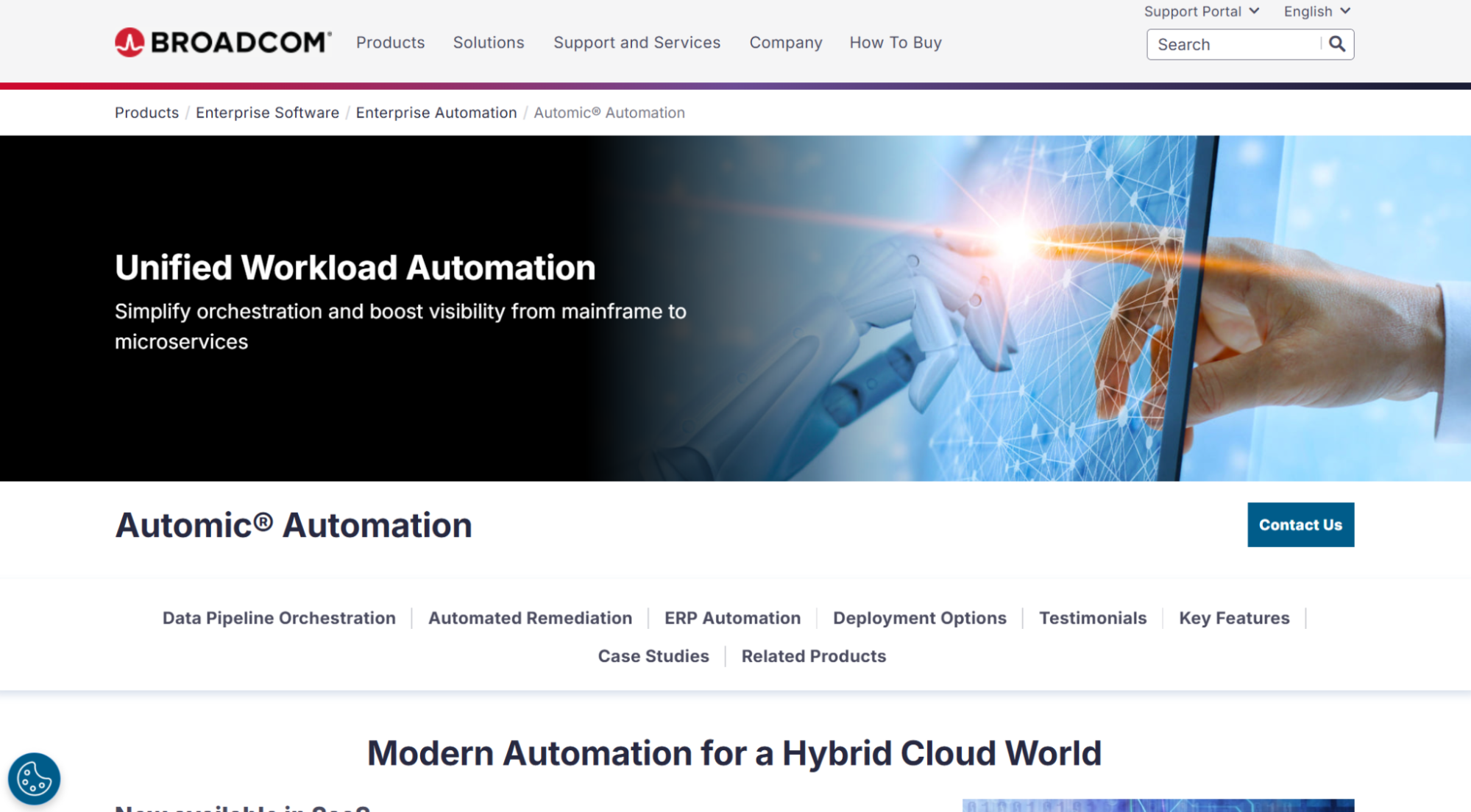
Broadcom’s Automic Automation (formerly CA Automic) is a long-established enterprise SOAP with strong roots in European markets. Automic supports hybrid/multicloud orchestration from mainframe to microservices and includes an AI-powered cross-vendor observability layer (AAI) for SLA management.
Key Features
Zero Downtime Upgrade: Automic’s flagship operational resilience feature, allowing upgrades without interrupting running workloads
Automation-as-Code: Expanded in 2025, enabling DevOps lifecycle management for automation workflows via modern CI/CD integration
Flexible Deployment: On-premises, containers (Kubernetes), and SaaS with 100% feature parity across all models
Where Broadcom Automic Shines
Zero Downtime Upgrade: A genuinely differentiating feature for enterprises running mission-critical batch processes that cannot tolerate maintenance windows
Broad integration ecosystem: Strong out-of-the-box support for enterprise applications, including SAP, with active industry vertical teams in finance, retail, and manufacturing
Where Broadcom Automic Falls Short
Customer experience concerns: Reported inconsistent experiences with Broadcom and its partners due to complex renewal negotiations and variable licensing flexibility. Broadcom also recorded a lower 12-month retention rate compared with other Leaders in the research.
Integration innovation pace: Gartner flags that Broadcom has been slower than peers to expand its integration library, particularly for emerging cloud services and niche DevOps tools
Customer Reviews
Vasundhra S. praises the platform, saying, “The ability to automate SAP applications is really the most advantageous feature of Automic. The speed is also surprisingly pleasant and saves a huge amount of time in real time. It is hands down the best ITPA tool available in the market right now that integrates and automates well with SAP.”
Shreyash R. warns, “Integrations with other applications is challenging and requires Web services to be available for the same. The UI was quite outdated, which recently was converted into a Web based application.”
Who Broadcom Automic Is Best For
Enterprises already on Broadcom’s product stack who need a unified vendor for automation and orchestration
Enterprises with complex SAP and hybrid-cloud workloads that can absorb the TCO
4. Redwood RunMyJobs: Best for SAP-Centric Orchestration
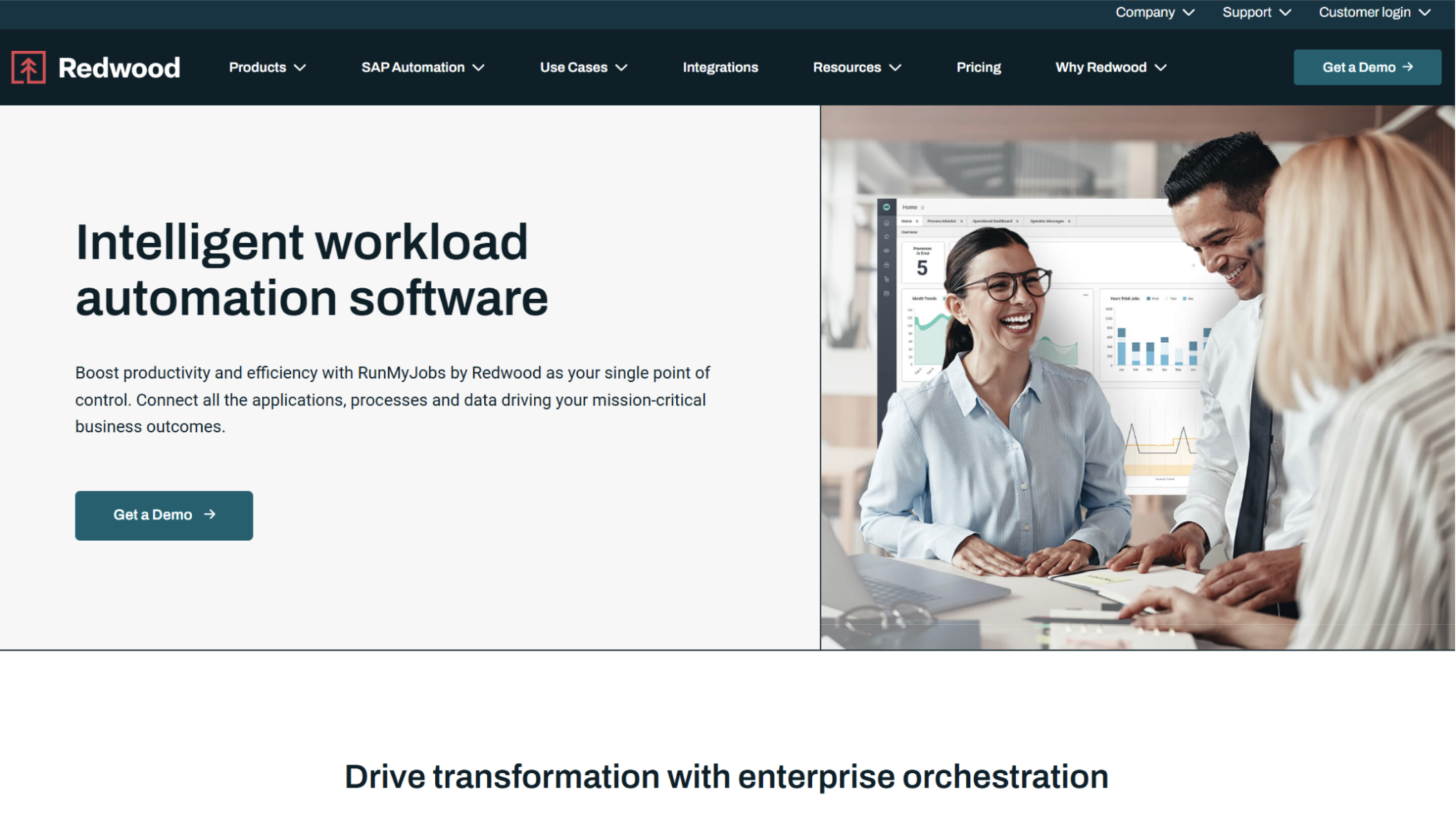
Redwood Software’s RunMyJobs is built around SAP orchestration and a low-code user experience. It's primarily delivered as a SaaS (multitenant) service, with self-hosting options available.
In 2025, Redwood launched Redwood Insights, an AI-powered observability layer that predicts SLA misses and explains process behavior in plain language.
Key Features
Deep SAP integration: RunMyJobs features one of the most complete SAP integration catalogs available, covering S/4HANA, BW, NetWeaver, and ERP processes via a low-code editor
Redwood Insights: AI-driven observability that analyses performance, predicts potential SLA misses, and provides natural language explanations of workflow behavior
Visual workflow editor: Drag-and-drop interface praised by Gartner customers for enabling IT operations and business analysts to build complex automations without deep scripting knowledge
Where Redwood RunMyJobs Shines
SAP orchestration depth: For enterprises whose critical processes are SAP-centered, RunMyJobs' integration catalog and native support for SAP variants are genuinely strong
User experience: Gartner customers consistently rate the low-code interface as one of the most intuitive in the SOAP market
Where Redwood RunMyJobs Falls Short
Data sovereignty limitations: RunMyJobs' primary multitenant SaaS model may not be well-suited for organizations in highly regulated industries with strict data sovereignty rules
Renewal pricing friction: Customer-reported cost increases during renewals are a consistent theme
Looking for more flexibility? Explore redwood alternatives.
Customer Reviews
Vandana S. praises, “I've been using RunMyjob Tool for a while now and I'm genuinely impressed with how much smooth and efficient it makes managing tasks. The interface is clean, user- friendly and easy to navigate, even for the one who are new to this tool.”
Ankush Y. notes, “The backend programming, which is not visible to us, hence makes it a bit difficult to identify the issue when there is a need to be and needs involving the support team.”
Who Redwood RunMyJobs Is Best For
SAP-heavy enterprises that prioritize low-code accessibility and intuitive workflow design
Organizations comfortable with a primary SaaS delivery model in non-regulated environments
5. Apache Airflow: Best for Data Engineering Teams
Apache Airflow is the dominant open-source workflow orchestration framework, originally built at Airbnb and now maintained by the Apache Software Foundation.
It uses a Python-based DAG (Directed Acyclic Graph) model to define, schedule, and monitor data pipelines. Managed Airflow services are available from Astronomer, AWS (MWAA), and Google Cloud Composer for teams that prefer a hosted experience.
Key Features
Python-native DAG definitions: Workflows are defined entirely in Python, giving data engineering teams maximum flexibility and version control integration
Extensive provider ecosystem: Hundreds of community-maintained connectors for cloud services, databases, and data platforms
Active open-source community: Large ecosystem of plugins, operators, and integrations maintained by thousands of contributors globally
Where Apache Airflow Shines
Data pipeline flexibility: Airflow is well-suited to complex ETL/ELT pipelines where data engineering teams want full programmatic control
Cost-effective for data teams: For organizations with strong Python expertise and a data-engineering-first culture, Airflow offers significant flexibility at low licensing cost
Where Apache Airflow Falls Short
Not designed for enterprise IT workload automation: Airflow lacks the enterprise features required for hybrid workload management with no native mainframe support, limited ITSM integration, no built-in SLA management dashboards, and no audit-grade compliance tooling
Operational overhead: Self-hosted Airflow requires significant DevOps resources to maintain at scale; version upgrades are notoriously complex
Pro Tip
If your team has outgrown Airflow and needs enterprise-grade hybrid orchestration with full IT workload management, read our Apache Airflow replacement guide
Customer Reviews
Brian K. praises, “What I like most about Apache Airflow is how it makes managing workflows feel organized and predictable. You can clearly define tasks, set dependencies, and see everything laid out in one place, which makes complex pipelines much easier to understand.”
Rajesh K. says, “When I create a task in expansion mode, it doesn’t display the graphical flow properly. I also noticed there’s too much logging. And when setting it up on AWS MWAA in a private VPC, it requires additional configuration.”
Who Apache Airflow Is Best For
Data engineering and DataOps teams running Python-centric ETL/ELT pipelines
Organizations where primary workload automation needs are data pipeline-focused, not cross-system IT orchestration
How to Choose an Automation Orchestration Platform
Choosing between SOAP platforms is rarely a pure feature decision. Here are the three dimensions that matter most for enterprise buyers.
Deployment Flexibility and Vendor Lock-In Risk
The orchestration platform you select will become core infrastructure. It needs to run where your workloads run, now and in the future. Evaluate whether the platform can operate consistently across SaaS, private cloud, and on-premises, and whether switching between deployment models requires a new contract or re-implementation.
ANOW! Automate is purpose-built for this. Its deployment portability allows organizations to move between SaaS, private cloud, and on-premises at any point, with no disruption to running workflows, eliminating the lock-in risk that legacy vendor contracts often create.
Integration Breadth and Extensibility
Enterprise environments are heterogeneous by definition. Your orchestration platform needs to connect everything (cloud services, databases, ERP systems, DevOps pipelines, ITSM tools, and legacy schedulers) without requiring custom engineering for every new connection.
ANOW! Automate ships with 600+ native connectors and an Infinite Integration methodology to integrate with any tool outside the standard library. This feature makes it one of the most integration-complete platforms in the market, relevant to the data pipeline orchestration and event-driven automation use cases that enterprise teams increasingly prioritize.

Integration Architecture
Discover Your Integration Possibilities
Connect your Beta Systems platform with the enterprise applications, APIs, and services that you already use. Streamline data exchange and orchestrate end-to-end workflows across your IT landscape.
Observability and SLA Intelligence
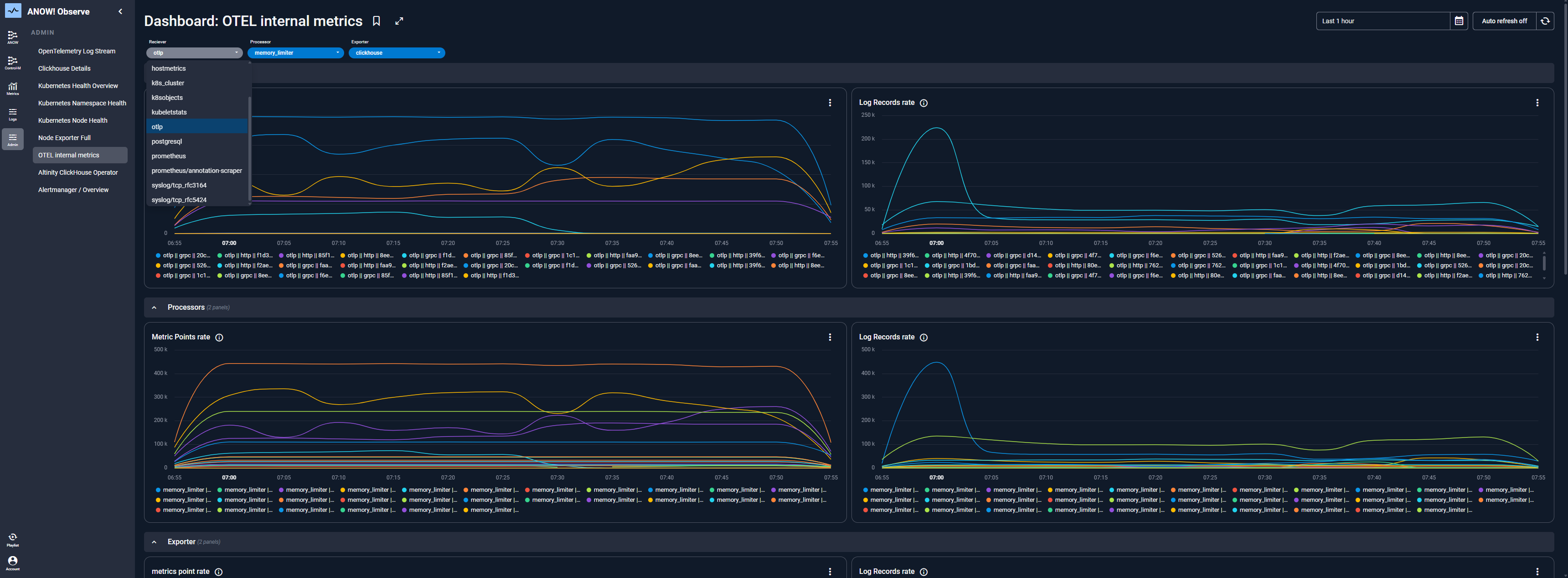
Knowing that a workflow ran is not enough. Enterprise teams need to understand why a workflow ran slowly, predict SLA risk before it materializes, and receive automated remediation suggestions without opening a ticket. This is increasingly a baseline expectation, not a premium feature.
ANOW! Observe delivers OpenTelemetry-native observability integrated directly into the orchestration engine, providing the real-time, telemetry-driven intelligence to detect anomalies, forecast SLA risks, and trigger automated remediation.
Read more: The future of workload automation
Automate Enterprise Processes Smartly with Beta Systems
If your organization is running workload automation on a legacy platform and feeling the pressure of rising costs, rigid contracts, or limited cloud flexibility, the market has matured enough to offer a genuine alternative.
Beta Systems ANOW! Suite is built precisely for this moment: a cloud-native, deployment-portable platform with 600+ native integrations, OpenTelemetry observability, and a migration pathway designed to minimize disruption. Enterprises already trust it in finance, manufacturing, insurance, and retail across Europe, North America, and APAC.
Frequently Asked Questions
1. What is the difference between workload automation and workflow orchestration?
Workload automation focuses on scheduling and executing IT jobs across systems and infrastructure. Workflow orchestration is broader: it coordinates sequences of tasks across applications, services, and humans, managing dependencies, conditions, and exceptions. Modern SOAPs combine both capabilities.
2. What should enterprises look for when replacing a legacy WLA platform?
The three most important factors are deployment flexibility (can the new platform run wherever your workloads run), integration breadth (does it connect your full technology estate without custom engineering), and migration support (does the vendor provide tooling and expertise to reduce cutover risk).
3. Is Apache Airflow suitable for enterprise workload automation?
Airflow is well-suited to data pipeline orchestration for Python-centric data engineering teams. However, it was not designed for enterprise IT workload automation as it lacks native mainframe support, enterprise SLA management, audit-grade compliance tooling, and the cross-system orchestration capabilities required for complex hybrid IT environments. Enterprises that have outgrown Airflow should evaluate purpose-built SOAP platforms.
Replace Legacy Automation Without the Risk.
Move off Control-M, Automic, or Redwood with a cloud-native orchestration platform built for hybrid enterprise environments. No downtime or vendor lock-in.
:quality(50))
:quality(50))
:quality(50))