:quality(50))
| Best For | Standout Features | |
|---|---|---|---|
Beta Systems ANOW! Suite | Large enterprises replacing legacy WLA | 500+ native integrations + built-in observability | |
BMC Control-M | High-volume mainframe-to-multicloud batch | Jett GenAI advisor for workflow troubleshooting | |
Broadcom Automic Automation | DACH enterprises on legacy Automic | Zero Downtime Upgrade + AI-powered observability (AAI) | |
Redwood RunMyJobs | SAP-centric enterprises | Deep native SAP/RISE integration | |
Stonebranch UAC | Teams wanting a modern cloud-native alternative | Universal Portal for self-service automation |
Why Choosing the Right Workload Automation Software Is Important
Picking the wrong platform doesn’t just mean you’re locked in with a clunky UI. It can translate to SLA breaches, manual firefighting, and a migration project a few years down the line.
Here are a few reasons this decision carries real weight.
It determines how much of your IT estate you can actually automate
A scheduler that only handles time-based triggers can’t manage the event-driven, cross-system dependencies most enterprises run today. Think of a job that needs to kick off the moment a file lands in an S3 bucket, or a workflow that has to pause and re-route when a downstream API returns an error.
Legacy, cron-style schedulers were built for static, time-based triggering; modern SOAP platforms are built for dynamic, condition-based orchestration across hybrid and multicloud systems.
Choosing a tool without that depth means you’ll keep bolting on scripts and workarounds instead of actually automating.
It shapes your TCO for years
Licensing is only part of the bill.
Administrator headcount, professional services for implementation, and renewal negotiations all add up and Gartner's Magic Quadrant for SOAP flags total cost of ownership as a specific caution for several legacy vendors in this list, noting that combined licensing and skilled-administrator costs can be hard to justify outside large, complex deployments.
Because most workload automation contracts run multi-year, a platform that looks affordable at signing can become a very different conversation at renewal.
It affects compliance and data sovereignty
Regulations like the EU’s DORA are pushing BFSI and insurance buyers toward platforms that can prove where data lives and who touched it, something not every SaaS-only vendor can guarantee.
This matters most for regulated industries with strict data residency requirements, where a multitenant, US-hosted SaaS platform may not clear procurement without significant extra configuration or a private deployment option.
It determines your operational resilience
Every platform in this category will eventually have a job fail, a node go down, or an SLA come under threat. The real differentiator is what happens next.
Platforms with real-time observability and AI-assisted troubleshooting built in can flag anomalies and forecast SLA risk before they cascade into an outage; platforms without it rely on your team noticing the alert and manually tracing the failure across systems.
That gap directly affects mean time to resolution, and at enterprise scale, it's the difference between a contained incident and a multi-hour outage.
:quality(50))
Enterprise vs. SMB Note:
Most of the tools below are built for enterprise automation consisting of large, complex environments with thousands of servers, cross-system dependencies, regulatory audit trails. If you're a smaller team that just needs a single-purpose scheduler (say, an SAP job scheduler or a cloud-native batch tool), a full workload automation platform is likely more capable than you need.
Key Benefits of Workload Automation Software
Here are the main perks of workload automation software to know about.
Fewer manual interventions, fewer errors
Centralizing scheduling, dependency management, and error handling in one platform removes the swivel-chair work of monitoring a dozen disconnected jobs.
→ Read more: What is workload automation?
Real-time visibility across hybrid environments
Modern platforms enable hybrid workload automation while surfacing SLA risk and job health before a failure cascades, instead of after an outage ticket is filed. An automation orchestration platform can bring those workflows, dependencies, and monitoring capabilities together across hybrid environments.
Gartner projects that by 2029, 90% of organizations currently delivering workload automation will use service orchestration and automation platforms (SOAPs) to orchestrate workloads and data pipelines across hybrid environments.
This is a sign that point schedulers are being phased out in favor of unified platforms.
AI-assisted troubleshooting is becoming standard, not optional
Gartner also expects 75% of SOAP workflows to leverage generative AI by 2029, with a 50% gain in troubleshooting efficiency, up from under 10% in 2025.
That’s reflected in this list: BMC's Jett advisor, Broadcom's AAI observability, and Redwood Insights are all recent additions built specifically to close this gap.
Pro Tip:
When comparing AI features across vendors, ask specifically whether the capability is a chat-style advisor (explains what happened) or a genuine predictive/remediation layer (flags SLA risk before it happens). Several vendors in this space still only offer the former.
1. Beta Systems ANOW! Suite: Best for Enterprise Workload Automation
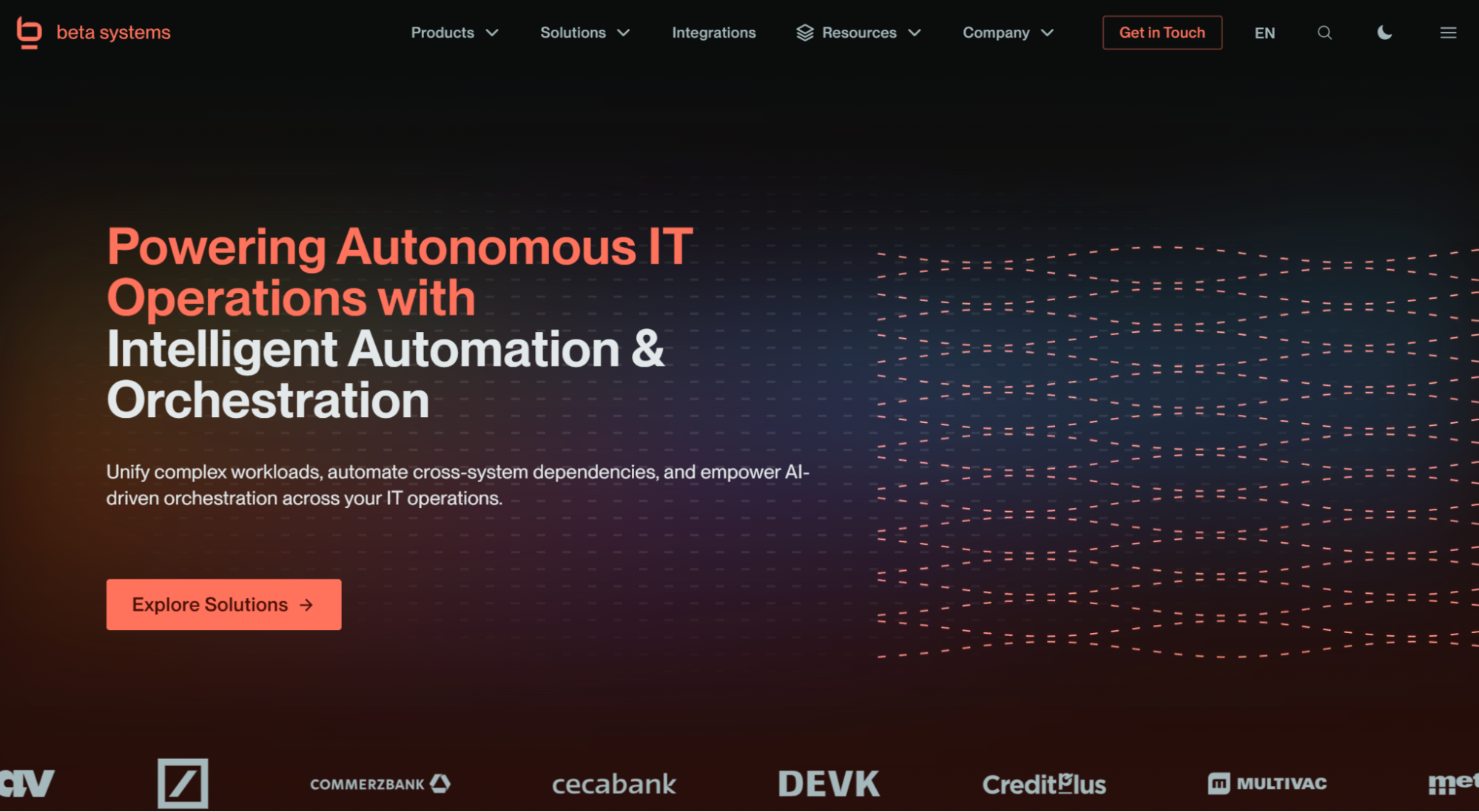
Beta Systems has spent four decades in enterprise data center automation, and its ANOW! Suite is the modern, cloud-native answer to that legacy, built specifically to bridge mainframe and hybrid-cloud environments rather than replace one with the other.
Gartner names Beta Systems a Leader, citing its unified observability and above-average customer retention among mission-critical BFSI, government, and insurance customers.
Beta Systems’ ANOW! Suite Key Features
Here are the stand-out features of ANOW! Suite that make it a winner.
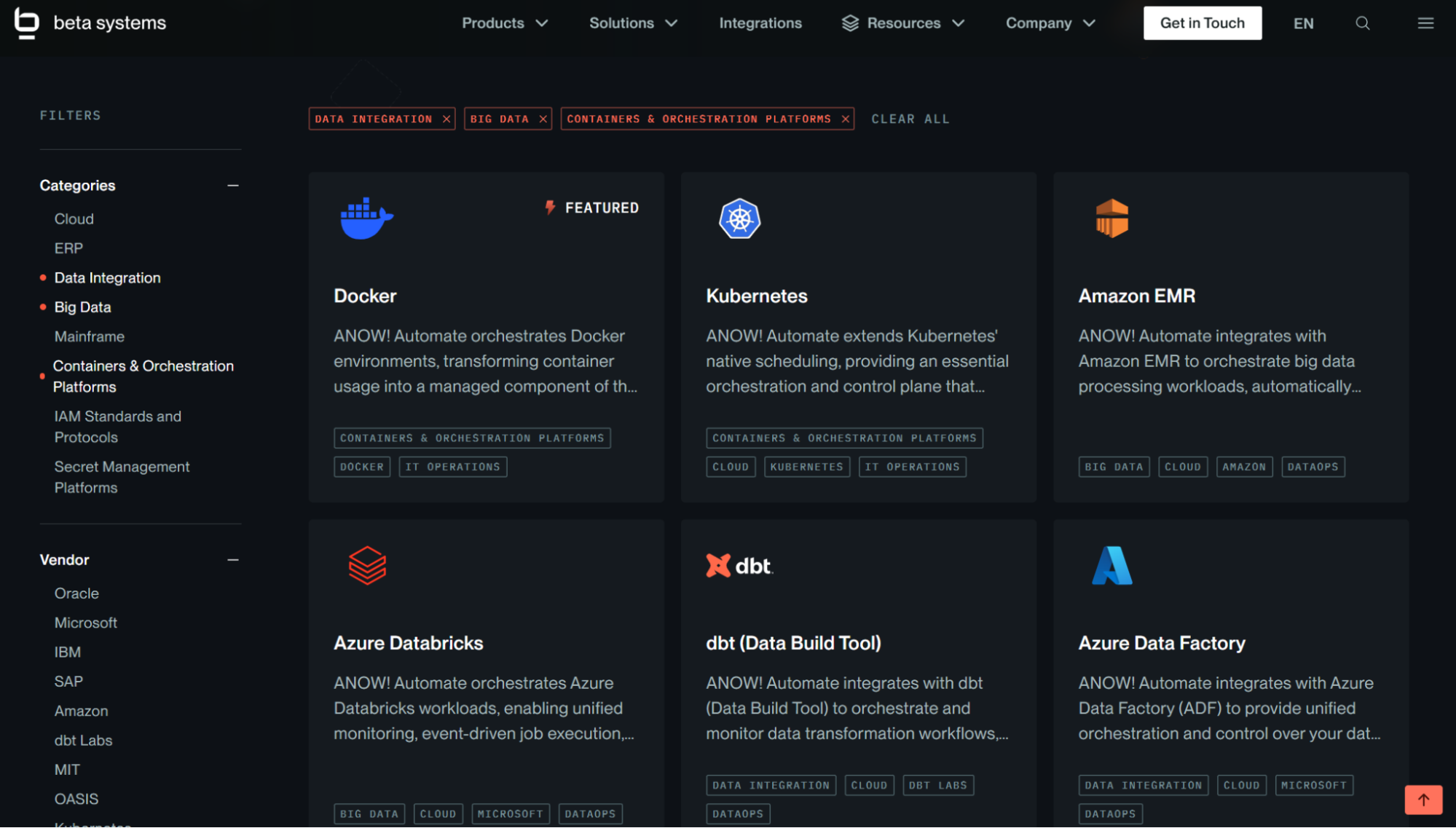
Infinite Integration 500+ native connectors
ANOW! Automate ships with more integrations than any other vendor in this list, spanning cloud (AWS, Azure, GCP), data platforms (Snowflake, Databricks, BigQuery), ERP, ITSM, and legacy schedulers.
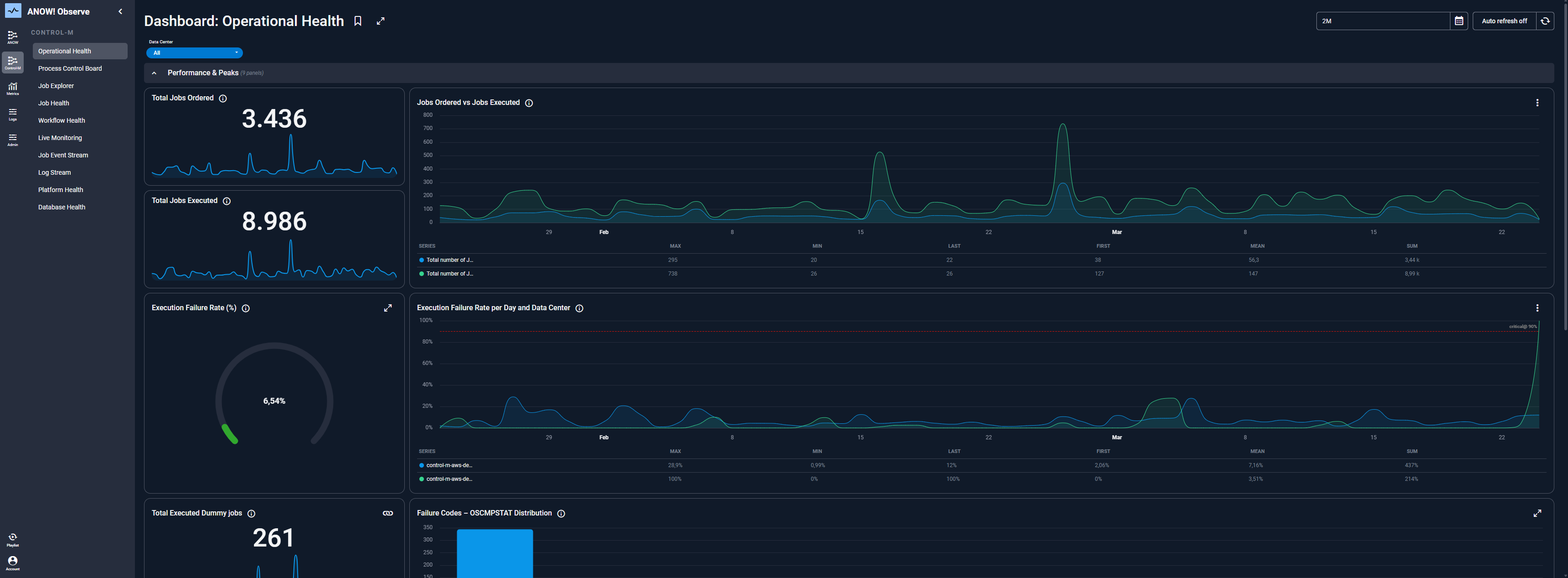
ANOW! Observe
OpenTelemetry-native observability is built into the orchestration engine itself, not bolted on, giving real-time SLA risk forecasting and anomaly detection across the full hybrid stack.
AI-powered PII filtering
ANOW! automatically detects and redacts sensitive data across workflows, simplifying GDPR and HIPAA compliance, a differentiator Gartner specifically called out.
Where Beta Systems’ ANOW! Suite Shines
No vendor lock-in: Deployment portability across SaaS, on-prem, and private cloud lets you change models without migration pain.
European data sovereignty: For regulated industries and DACH buyers specifically, ANOW! offers a European-hosted alternative to US-based SaaS-only vendors.
Fastest migration path off legacy schedulers: Zero-touch migration tooling and a low-code interface reduce the multi-month ramp-up typical of Control-M or Automic replacements.
Beta Systems Software is Recognized as a Leader in the 2026 Gartner® Magic Quadrant™
Discover why analysts trust Beta Systems to deliver enterprise-grade workload automation and observability at scale.
:quality(80))
Where Beta Systems’ ANOW! Suite Falls Short
UI available in only four languages (English, German, Polish, and Japanese): A redesign is underway, but multilingual global rollouts may need to wait.
Smaller brand footprint outside Europe: ANOW!'s customer base is concentrated in Europe, so North American and Asia/Pacific buyers may find fewer local reference accounts than with BMC or Redwood.
Beta Systems’ ANOW Suite! Customer Reviews
One user shares, “I really like that everything is in one place. It gives me a 'single point of control' for all my tasks and workflows, which makes it much easier to see what is happening in real-time.”
Another user praises the centralized nature, saying, “It helps me organize tasks, track progress, and maintain better visibility across ongoing activities. What I like most about ANOW! Suite is its ability to bring everything into one centralized platform. It makes task management and tracking very intuitive, improves visibility across workflows, and helps me stay organized.”
Who Beta Systems ANOW! Suite Is Best For
CIOs and Heads of IT Operations consolidating multiple legacy schedulers into one platform with predictable, sovereign pricing
BFSI, manufacturing, and insurance enterprises running hybrid mainframe-to-cloud environments that need audit-ready compliance
Automation CoE leads looking to replace Control-M, Automic, or AutoSys without a multi-year rip-and-replace project
One Platform for Modern Enterprise Automation
Combine workload automation, orchestration, and observability in a single cloud-native platform built for complex IT environments.
2. BMC Control-M
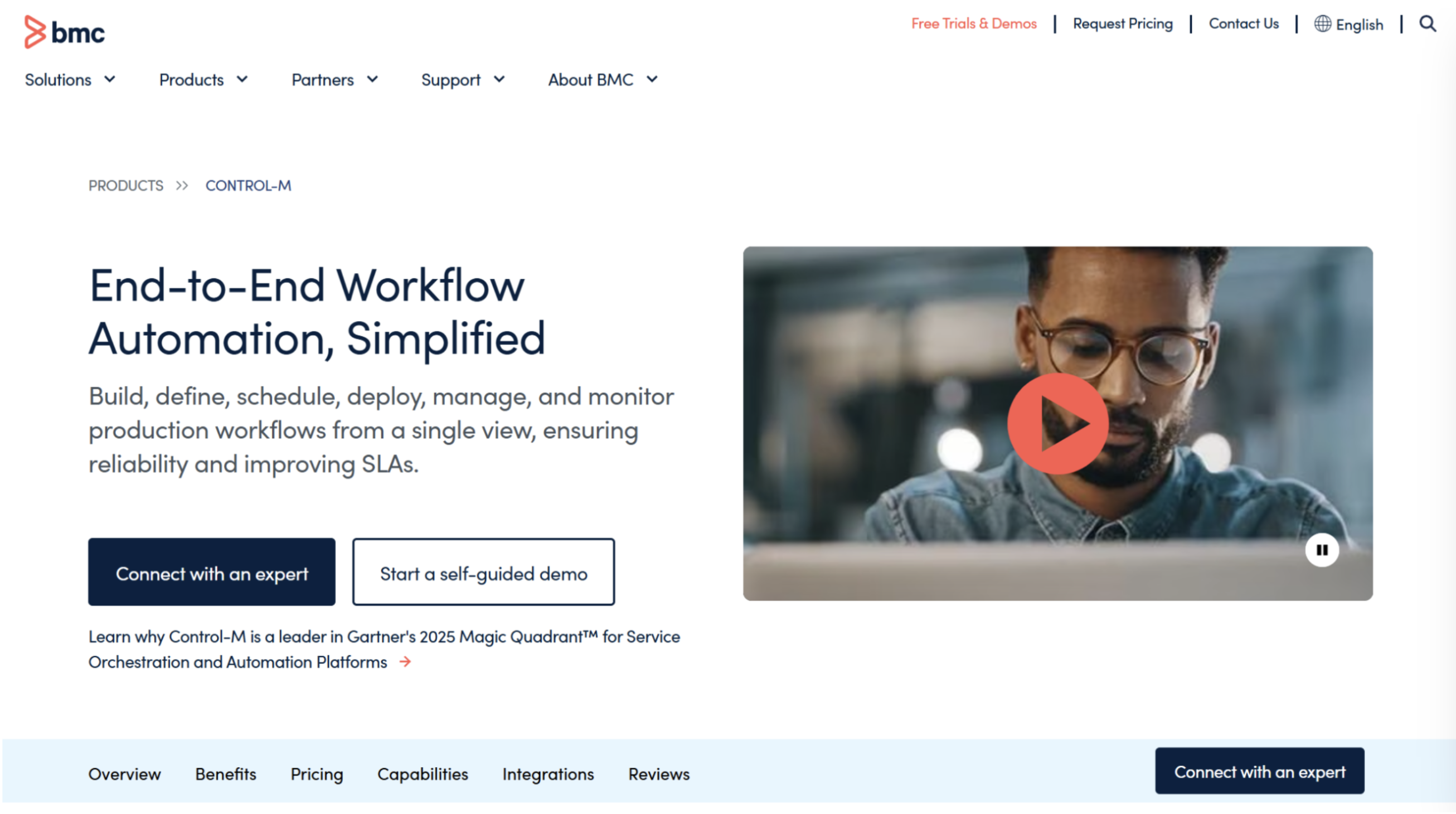
Control-M is BMC’s long-standing SOAP offering and, per Gartner's 2025 Magic Quadrant, a Leader with orchestration spanning mainframe to multicloud through a “Unified View” interface.
In April 2025, BMC split into two independent companies (BMC and BMC Helix) and in June 2026, BMC Helix's majority stake was acquired by Montagu, meaning it’s no longer under common ownership with BMC Software.
Gartner notes some customers have expressed concern about longer-term support continuity across products split between the two companies.
Key Features
Jett, BMC’s GenAI advisor: Embedded directly in Control-M, Jett lets users ask natural-language questions about workflows and get graphical/textual answers, aiding troubleshooting and compliance checks.
Cross-platform orchestration: Native support for mainframe, multicloud, and AI/ML/DataOps pipelines in a single console.
Unified View: A single interface for building, running, and managing workloads across self-hosted and SaaS deployments.
Where Control-M Shines
Deepest mainframe-to-cloud coverage: Few competitors match its breadth across legacy mainframe and modern multicloud in one product.
Mature partner ecosystem: A strong VAR and global systems integrator network supports large, complex rollouts.
Where Control-M Falls Short
Higher total cost of ownership: Best suited to organizations that can absorb both licensing and dedicated administrator overhead as smaller teams often find it more than they need.
Recent corporate split creates uncertainty: The BMC/BMC Helix separation, followed by the Montagu acquisition of Helix, has some customers watching for support and integration friction across the two companies’ product lines.
For teams prioritizing cloud-first operations, cloud scheduling software may offer a simpler alternative to Control-M's enterprise-heavy approach.
Customer Reviews
Shaik A. praises, “What I like best about Control-M is its powerful automation and centralized workflow management. It allows me to schedule, monitor, and manage jobs across multiple systems from a single interface, which makes operations much easier and more efficient.”
Dadaso P. warns of three things, high licensing costs, complex administration, and older UI, saying, “It is an enterprise product, and licensing can be expensive, especially for smaller organizations. Initial setup, upgrades, and maintenance often require experienced administrators. Although BMC has modernized parts of the product, some screens and workflows can still feel dated compared to newer cloud-native tools.”
Who Control-M Is Best For
Large enterprises with high-volume, mainframe-anchored batch processing that need deep native mainframe support and can budget for enterprise-grade licensing
If Control-M feels like more than you need, it’s worth looking at Control-M alternatives.
3. Broadcom Automic Automation
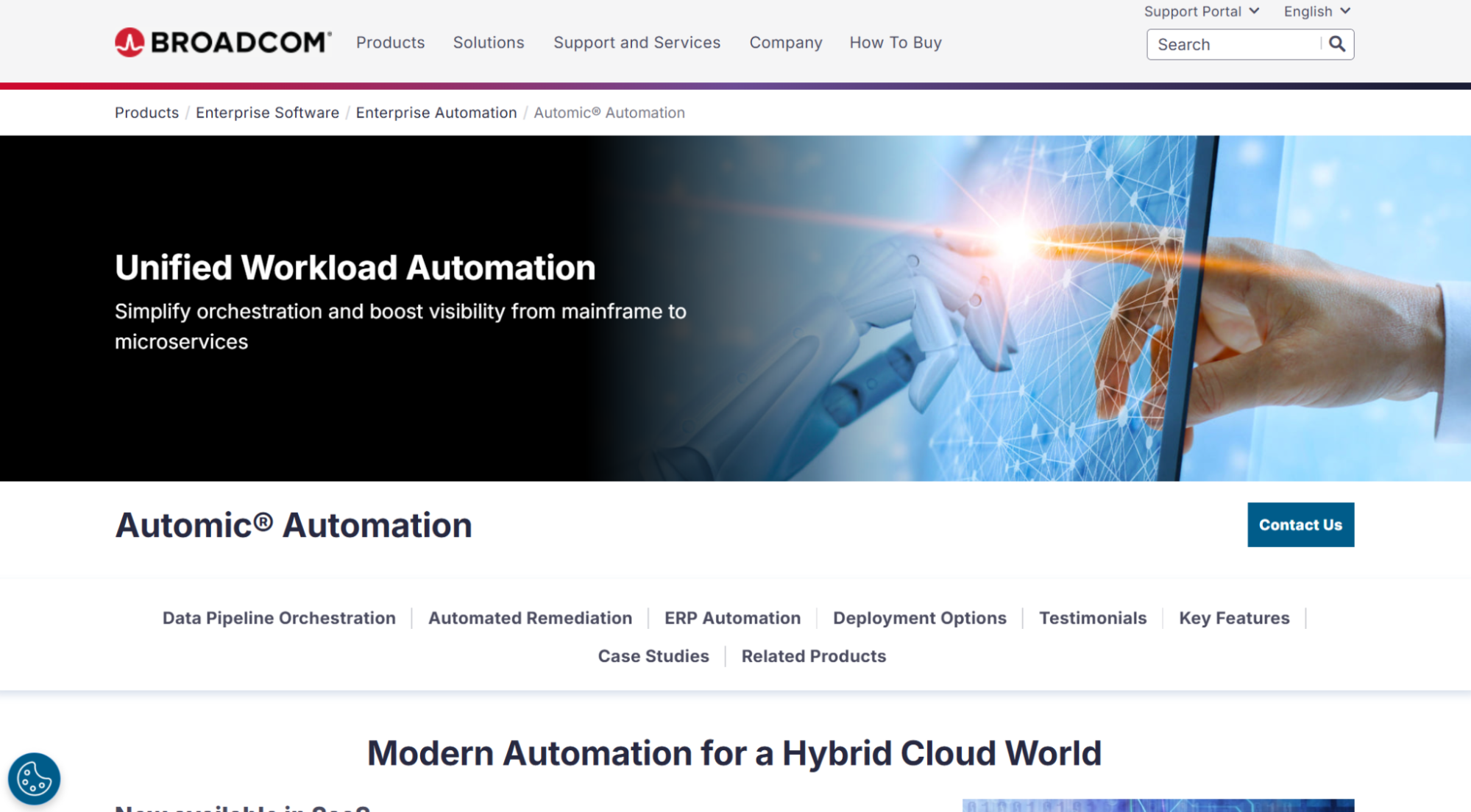
Automic Automation is Broadcom's SOAP offering, supporting hybrid deployment (on-prem, container, or SaaS) with orchestration from mainframe to microservices.
It’s a common incumbent among European and DACH enterprises that adopted Automic before Broadcom's acquisition of CA Technologies.
Key Features
Zero Downtime Upgrade: Allows version upgrades without interrupting running workflows, valuable for always-on enterprise environments.
AAI (AI-powered observability): Cross-vendor observability with predictive insights and SLA management.
Flexible deployment: Supports on-premises, containerized, and SaaS models for hybrid IT estates.
Where Automic Shines
Broad hybrid deployment flexibility: On-prem, container, or SaaS; one of the more flexible deployment stories among legacy vendors.
Established vertical expertise: Broadcom maintains dedicated sales teams for finance, retail, and manufacturing.
Mature mainframe-to-microservices orchestration: A long track record with complex, large-scale environments.
Where Automic Falls Short
Slower integration expansion: Gartner notes Broadcom has been comparatively slow to grow its out-of-the-box integration library versus other Leaders, meaning some cutting-edge cloud or DevOps tools require custom-built connectors.
Customer experience concerns: Broadcom has reported a lower 12-month customer retention rate than other Leaders in Gartner’s research, with some customers citing complex renewal negotiations and inconsistent licensing flexibility.
Customer Reviews
Sandhya A. praises, saying, “Using Automic, we can easily schedule and deploy the workflows. Automic Automation lets you manage complex workflows that span across multiple technologies.”
Alfredo C. warns of many possible pain points, including that “The debugger could be more analytical and descriptive. Dashboard-building features should offer more flexibility and options. Some processes could be more intuitive, and above all, troubleshooting could be more guided.”
Who Automic Is Best For
European and DACH enterprises already standardized on Automic who need continued hybrid and mainframe orchestration without an immediate full migration
4. Redwood RunMyJobs
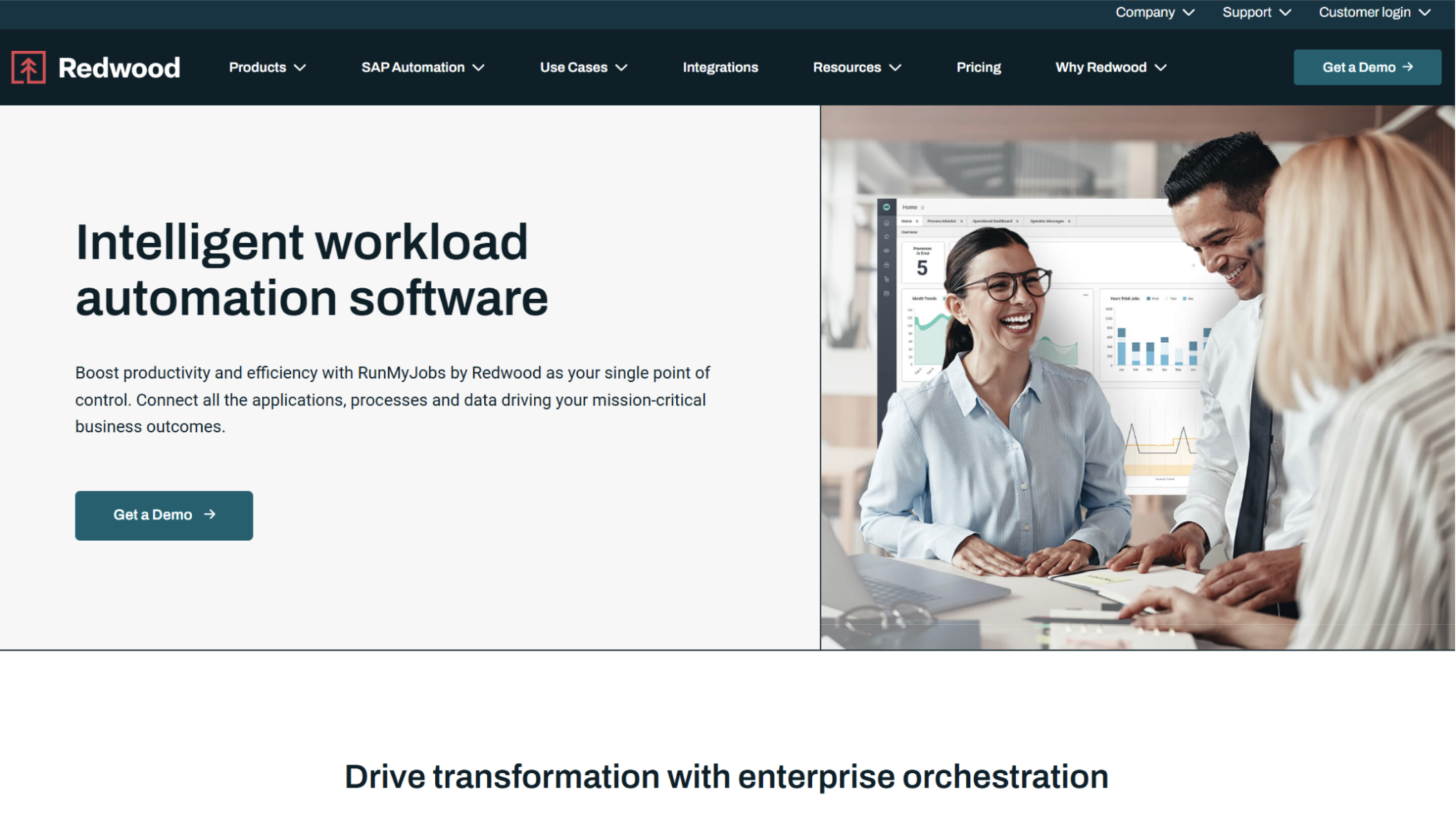
RunMyJobs by Redwood is one of the most recognized names for SAP-centric automation, commonly consumed as SaaS. However, it’s a core legacy vendor many BFSI and manufacturing organizations are migrating away from often due to renewal pricing pressure.
Key Features
Deep native SAP integration: RunMyJobs is positioned as an SAP-endorsed app within the RISE reference architecture, making it a strong fit for SAP-heavy ERP shops.
Redwood Insights: An AI-powered observability layer that predicts SLA misses and explains process behavior in plain language.
Low-code, drag-and-drop editor: Gartner notes positive customer feedback on ease of use for both IT and business-analyst users.
Where RunMyJobs Shines
Strong SAP ecosystem fit: Particularly favored by organizations running RISE with SAP S/4HANA.
Fast, low-code workflow building: Reviewers frequently cite ease of administration as a differentiator versus Control-M and Automic.
Where RunMyJobs Falls Short
SaaS-first model limits data sovereignty options: Gartner flags this as a constraint for organizations in highly regulated industries with strict sovereignty requirements, though on-prem and private-cloud options exist.
Renewal pricing concerns: Customers have expressed frustration with cost increases during renewal negotiations, plus friction for enterprises relying on global systems integrators due to Redwood's direct sales model.
Customer Reviews
Alex S. praises, “It has been stable, we no longer have manual pre and post activities for RMJ patching and have gained confidence in the stability of your patch cycles. Clear improvement over our old On-Prem setup from the past.”
Mamta N. warns, “Some sections can take a little time to get familiar with when using them for the first time. I have also noticed that filtering candidates in very specific ways sometimes requires a few extra steps.’
Who RunMyJobs Is Best For
SAP-centric enterprises, especially in BFSI and manufacturing, modernizing batch automation around ERP-heavy, RISE-aligned environments
→ Read more: Redwood alternatives to know
5. Stonebranch Universal Automation Center (UAC)
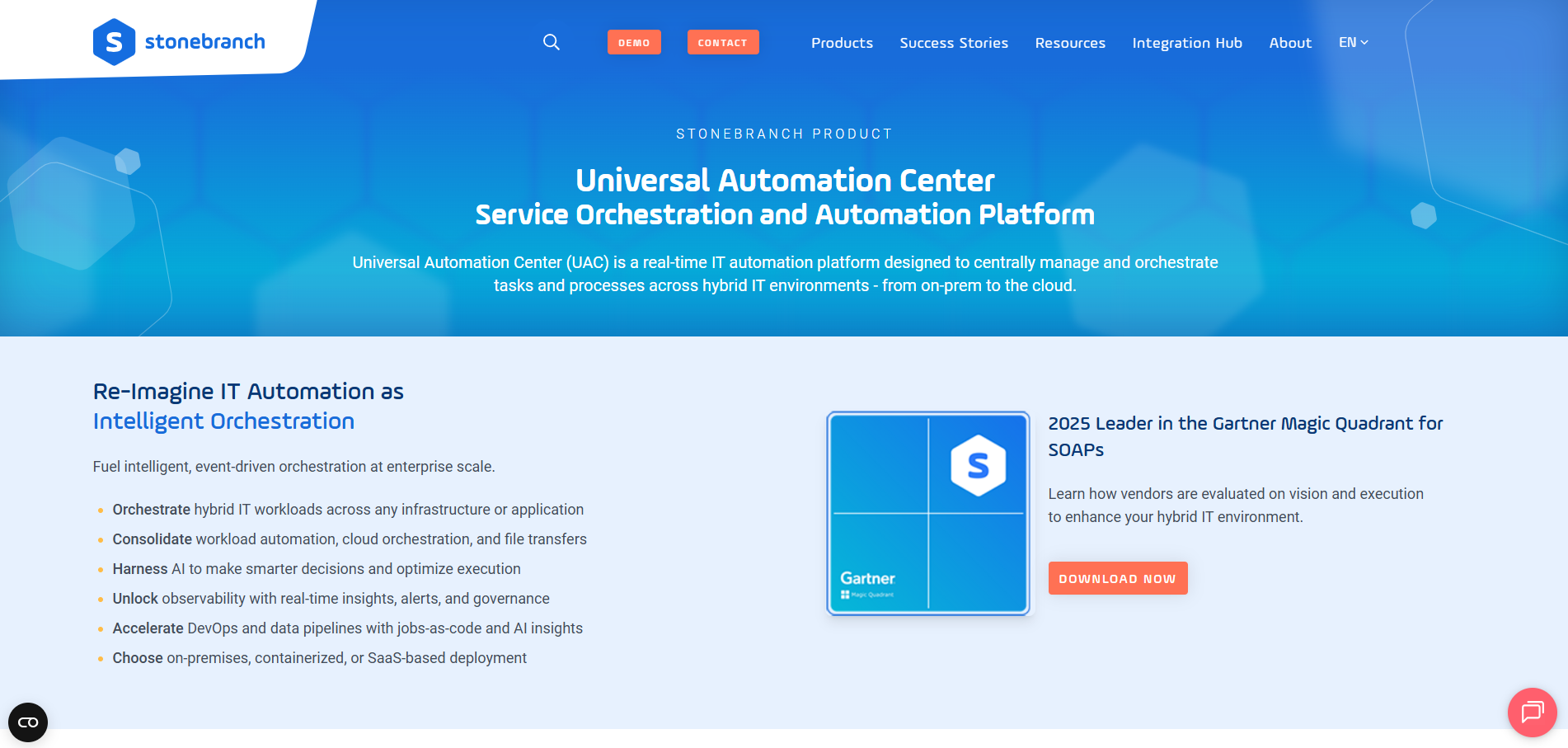
Stonebranch is the one genuinely modern, cloud-native competitor in this list and is deployable as self-hosted software or SaaS, with a 2025 launch of its Universal Portal for self-service automation.
Key Features
Universal Portal: Enables self-service automation across skill levels, from any device.
Data Pipeline Orchestration: A dedicated, purpose-built module for managing complex modern data-stack pipelines (Snowflake, Databricks, dbt).
Low-code workflow designer: Gartner cites strong customer feedback on the intuitive, web-based UI for non-developers.
Where Stonebranch Shines
Purpose-built data pipeline orchestration: A genuine differentiator for DataOps-heavy teams.
Expert-led migration services: Customers report consistently smooth transitions when moving from a legacy SOAP to UAC.
Where Stonebranch Falls Short
Earlier-stage AI capabilities: Gartner notes Stonebranch’s Robi AI is in early access and currently limited to documentation, task definitions, and reporting, behind competitors offering GenAI-assisted troubleshooting.
Lower brand awareness relative to other Leaders: As a pure-play automation vendor, Stonebranch may not be on the radar of buyers already running “good enough” automation inside a larger platform which is also where ANOW!’s broader suite (workload automation, observability, and AI-driven insights in one place) offers a meaningful trade-off versus a point solution.
Compare enterprise job scheduling software for modern IT estates.
Customer Reviews
Jeff V. praises, “I use Stonebranch to automate and centralize operations, like scheduling jobs and moving files securely, connecting different applications so everything runs smoothly. I like how I can see all my workflows from one place, which helps me monitor and fix issues faster, and ensure processes run on time.”
Stephen E. notes, “My main problem was with the setup process. Although the knowledge base contains a lot of information, it can be somewhat difficult to navigate at times. There are definitely sections where, if you overlook something, you might find yourself stuck.”
Who Stonebranch Is Best For
Teams that already want a modern, cloud-native platform and are comparing pricing, lock-in, and breadth of platform factors
Replace Legacy Schedulers Without Disruption
Migrate from outdated workload automation tools with flexible deployment options, built-in integrations, and zero-touch migration support.
How to Choose Workload Automation Software
With the field narrowed to five strong options, here's what actually differentiates them in a real evaluation.
Total Cost of Ownership, Not Just License Price
Legacy vendors in this list, like Control-M and Automic in particular, carry meaningful administrator and services overhead on top of licensing.
ANOW! Automate’s deployment portability (SaaS, private cloud, or on-prem, switchable without disruption) is built specifically to avoid the re-architecture costs that come with rigid legacy licensing models.
Data Sovereignty and Compliance Requirements
If you’re a European enterprise or operate under DORA, GDPR, or similar frameworks, a SaaS-first, US-based vendor may not fully meet sovereignty requirements without additional configuration.
ANOW! Automate is built around European data sovereignty by default, alongside AI-powered PII filtering for automatic compliance support.
Depth of Integrations vs. Breadth of Platform
A narrow scheduler with 100 connectors will eventually hit a wall in a hybrid, multi-cloud estate.
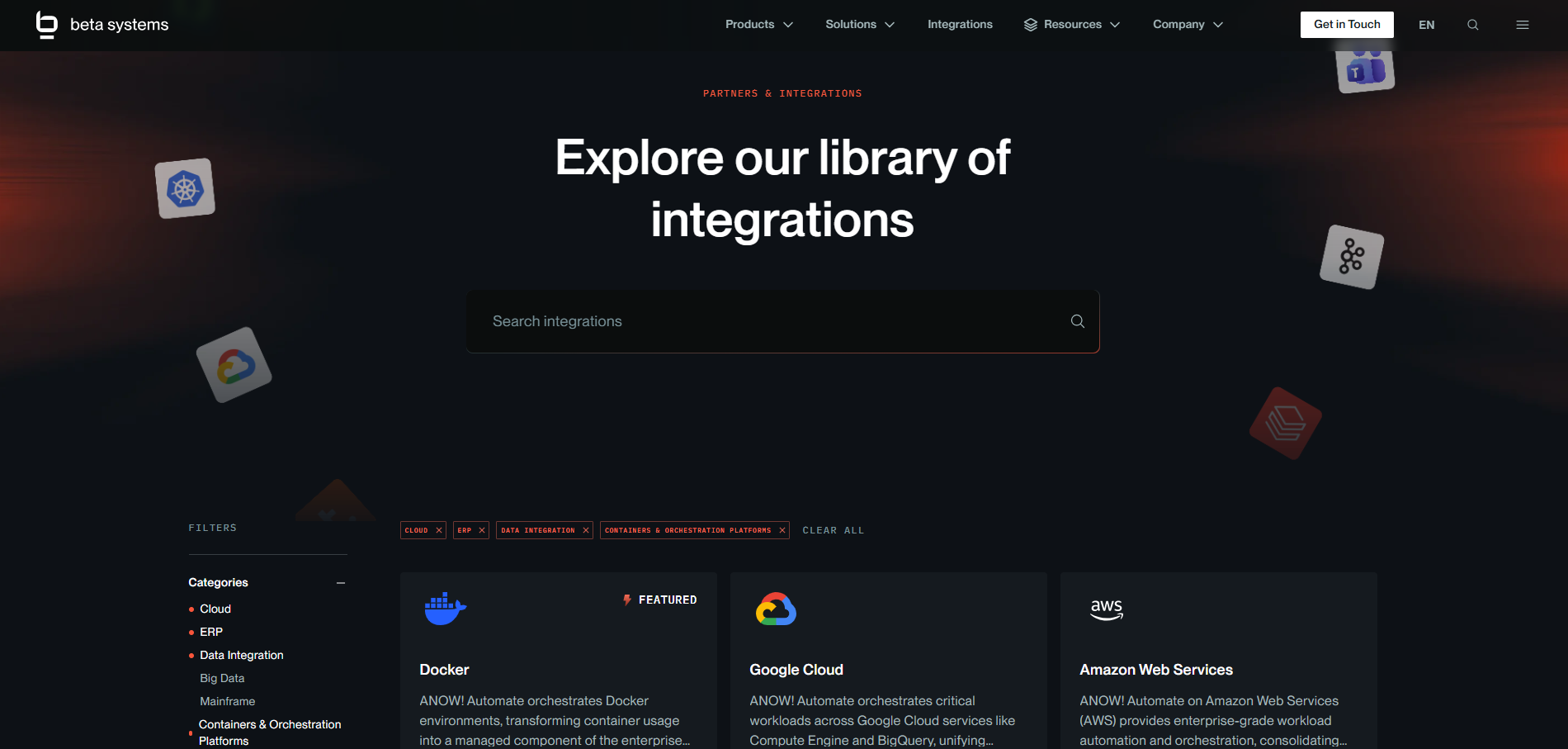
ANOW! Automate’s 500+ native integrations, which is the largest library among vendors compared here, come combined with its Infinite Integration framework for anything outside the standard catalog, reduces the odds of hitting an unsupported system mid-migration.

Integration Architecture
Discover Your Integration Possibilities
Connect your Beta Systems platform with the enterprise applications, APIs, and services that you already use. Streamline data exchange and orchestrate end-to-end workflows across your IT landscape.
Fix Complex Workflows With Beta Systems' Workload Automation Software
If you’re replacing a legacy scheduler because of price hikes, poor support, or a platform that can’t keep pace with hybrid cloud, ANOW! Automate is built specifically for that transition with the integration depth, observability, and European sovereignty that BMC, Broadcom, and Redwood weren’t designed around.
If you’re already on a modern platform like Stonebranch and it’s meeting your needs, the switching case is weaker; but if you’re mid-evaluation, it’s worth seeing the migration path for yourself.
Talk to Beta Systems about migrating to the ANOW! Suite today.
See Your Migration Path Forward
Find out how ANOW! Automate helps enterprises modernize workload automation without rebuilding critical workflows.
:quality(50))
:quality(50))
:quality(50))