Video

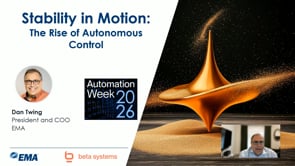
Stability in Motion: The Rise of Autonomous Control

dan_twing_portrait.jpg
Dan Twing
President and COO of Enterprise Management Associates (EMA)

Join Dan Twing, leading analyst and author of EMA’s Radar Report on Workload Automation and Orchestration, to explore how automation teams can remain stable while everything around them accelerates.

In this keynote, he will examine the shift from traditional workload automation toward more intelligent, autonomous control. Discover how orchestration, observability, and AI are reshaping IT operations – and what this transformation means for maintaining stable, reliable production in an era of continuous change.

Video Information:

  • Language: English

  • Subtitles: English, German

Video thumbnail

Author

dan_twing_portrait.jpg
Dan Twing
President and COO of Enterprise Management Associates (EMA)

As President and Chief Operating Officer of Enterprise Management Associates, Dan is responsible for developing and executing strategic market research, delivering value to IT organizations through consulting engagements, and directing product developments and marketing efforts. Dan joined EMA in 2005 and has over 30 years of experience in information systems, software development, and technology outsourcing. Dan focuses on all aspects of intelligent and automated management of IT. Prior to joining EMA, Dan was the president & CEO of NETdelivery, a company that develops secure electronic data collection, delivery, and management software for Fortune 1000, financial, and government markets.

Further Resources

Blog Article
blog-post-hybrid-cloud-orchestration.png

Hybrid Cloud Orchestration: Complete Guide (2026)

Managing workloads across private clouds, public clouds, and on-premises infrastructure without a unified control layer is like running a logistics operation across five countries with no shared dispatch system. Every team moves fast but nothing moves together. Hybrid cloud orchestration solves exactly this. It coordinates workloads, data pipelines, and services across your entire hybrid environment, so execution is consistent, dependencies are tracked, and teams have full visibility in real time. Keep reading to learn more about what hybrid cloud orchestration is, why it’s difficult to get right at enterprise scale, how it works in practice, and which platforms are built to handle it.
Blog Article
blog-post-workflow-automation.png

Enterprise Workflow Tools: 7 Best Platforms (2026)

If your organization runs hundreds of automated jobs across cloud, on-premises, and mainframe systems, you need more than a basic scheduler. You need an enterprise workflow automation platform that manages complex dependencies, enforces SLA compliance, and gives your operations team real-time visibility into every process. The tools in this list range from purpose-built workload automation platforms to ITSM-native engines and data pipeline orchestrators. Each is included for the unique value add each brings to the table.
Blog Article
Enterprise Automation Software Cloud Environment

Multi-Cloud Management: How Workload Automation Simplifies the Process

A few years ago, cloud strategy was simple: pick a provider, migrate, and optimize. Fast-forward to today, and that same approach feels outdated. Enterprises now operate in increasingly complex IT ecosystems, running workloads across multiple cloud providers and often in hybrid environments. What once was a linear migration path has evolved into a dynamic, distributed architecture. This evolution is driven by flexibility, innovation, and cost-efficiency. But it’s also introduced a new set of challenges – governance, visibility, compliance, and operational complexity. The question is no longer whether to use multiple clouds, but rather how to manage them effectively. That’s where multi-cloud management and modern workload automation come in. Let’s explore what multi-cloud management is, why it matters, and how proper automation can help you gain an edge.